Not Easy

This morning, I found an article with some verses on determination, strength, endurance, and perseverance here:

https://walkinlove.com/blogs/walk-in-love/10-bible-verses-about-determination-and-strength

But my favorite verse that they didn’t reference is:

We can rejoice, too, when we run into problems and trials, for we know that they help us develop endurance. And endurance develops strength of character, and character strengthens our confident hope of salvation. And this hope will not lead to disappointment. For we know how dearly God loves us, because he has given us the Holy Spirit to fill our hearts with his love.
Romans 5:3‭-‬5 NLT

And our morning devotional was about the value of not isolating in times of trial, but ther value of teamwork and fellowship:

Two people are better off than one, for they can help each other succeed. If one person falls, the other can reach out and help. But someone who falls alone is in real trouble. Likewise, two people lying close together can keep each other warm. But how can one be warm alone? A person standing alone can be attacked and defeated, but two can stand back-to-back and conquer. Three are even better, for a triple-braided cord is not easily broken.
Ecclesiastes 4:9‭-‬12 NLT

Lord, it would be foolish of us to ask you for more trials so that we might grow in strength and endurance — to what end would that serve unless we are seeking to glorify ourselves? But Lord, when we are already suffering, when we see how short we have fallen from glorifying you alone with our lives, when we find ourselves hopeless and isolated by the snares of the enemy, help us to turn to you for the victory and to find you in those around us. Help us to not isolate where we ate more prone to depression and anxiety, but help us to be genuine and transparent with those who love us. Don’t let the enemy convince us that those who love us are against us, or that our challenges are heavy and burdensome and must be quietly squirreled away to fester instead of shared and lightened. If we must suffer, let us suffer well for your glory — but let joy and peace and hope and faith and live reign abundant in our lives as a testimony of your faithfulness, oh Lord. We give you all the glory and praise. Amen.

Didn’t Get the Announcement

If they do not believe our communications are clear, trustworthy, and of value to them — we have little opportunity for communication to occur, no matter how loudly we announce something.

At work, we have a weekly “All Hands” phone call that everyone company wide is supposed to listen to. However, my department is not able to listen in to the live call, because it is scheduled during our highest volume of work with customers. So the call is recorded for us and we are supposed to call back in at a later time that won’t impact or normal work flow to listen to the call. And there are memos and emails and notices sent out to us from management and from our own team members to make us aware of different things that affect or jobs.

It is repeatedly evident which people on our team listen to the call and read the communications and which do not, because you’ll hear them ask a question that was answered in the “announcement” and someone else who read it then gives them a summary and says, “It was in the (call/email/etc). Check it for the details.”

The hope would be that after their missing the communications happens enough times, that they might see the value in listening to and reading these communications for themselves regularly. But it doesn’t always work that way.

So just because an announcement is made, it doesn’t mean that it is received. And even when it is received, if the message isnt clearly explained or if the recipient doesn’t seek to understand what is being communicated — the intended message is not always comprehended by the recipient in the manner that was intended by the sender. Effective communication has several points at which it can break down.

I am not the supervisor of our team at work, but as a leader and mediator by nature, I end up stepping in to help my teammates regularly when there are technology issues, personal issues, questions, concerns, etc. And the team members regularly come to me with these problems because I will take action — whether or is a technology issue that needs to be addressed by the infrastructure team, whether it is an issue with something another team member did, or whether it is a question or concern about something management has communicated — they know that I will look into the issue, reach out to the appropriate resources, and track and follow up on the issue until it had been remedied.

Because of this, I am usually the member of the team that is addressing “issues” directly with those who can “fix” the problem. Even though others might be loud within their own comfortable circle that listens to their gripes and complaints, they might never communicate the problem/complaint directly to the person they are complaining about who could actually make a change that would improve things.

And being in this position of always “seeking to move the team forward towards resolution of issues” rather than “leaving issues to either wither away or fester” can be challenging at times — especially when most people don’t want to hear about issues that might take effort on their part to resolve. Most people by nature are prideful and self defensive when it comes to any type of announcement calling for change on their part — so the messenger needs to either wear a flak jacket or learn to move like Keanu Reaves in The Matrix to avoid getting shot.

It’s wonderful when you encounter someone who is “reachable”, someone who is “teachable”, someone who will value input from others, receive what is being said without practicing a response even before the message is complete, consider what is being communicated, comprehend and seek seek to remedy the situation. But that is not always the case. Resistance to what is being communicated is real, and there is not always unity of purpose, strong work ethic, a willingness to put aside self interests for the sake of the team, or comprehension in every instance where communication is attempted.

We can work on our skills to perfect or communications for sure:

But at the end of the day, the recipient must be willing to receive and comprehend, or we can’t help them. If they do not believe our communications are clear, trustworthy, and of value to them — we have little opportunity for communication to occur, no matter how loudly we announce something.


And we can see this is true of this Good News that we shout from the mountaintops as well:

For this good news—that God has prepared this rest—has been announced to us just as it was to them. But it did them no good because they didn’t share the faith of those who listened to God.
Hebrews 4:2 NLT

Life Application Study Bible
The Israelites of Moses’ day illustrate a problem facing many who fill our churches today. They know a great deal about Christ, but they do not know him personally-they don’t combine their knowledge with faith. Let the Good News about Christ benefit your life. Believe in him and then act on what you know. Trust in Christ and do what he says.


Lord, help us to communicate clearly, in a message relevant to our listeners, in a timely fashion, with a truthful and trustworthy message, providing a solid foundation for our message, providing adequate detail to allow for a comprehensive understanding of our ideas, in a visual manner without conflicting or confusing the message, being caring and compassionate, and majoring ourselves available and open to feedback. And when we have done our best, help us to trust you to carry the right message, in the right time, to the right recipient, for the right purpose. Help us to share this most important message, your Good News, to the ends of the earth. Amen.

Lead through Suffering

When I used to lead my own department, I found that the best way to become a trusted leader among your team was to be willing to take upon yourself the hardest tasks and the most challenging situations.

If there was something that had to be done in the late hours of the night, I was the one willing to do it — I was the first that would step up to the plate and volunteer, even though I was the “boss”. And by doing this consistently, my team saw this example time after time again, and eventually they started stepping up themselves and volunteering as well — because they saw the sacrifice that their “leader” was willing to make, and they began striving for those same things.

We didn’t have people grumbling about having to come in and work over the weekend, because it was a voluntary thing. In fact, it was a badge of honor that meant you were willing to submit yourselves to that challenge — to that suffering “on behalf of your team”. And the people who bought into being a part of a flourishing and unified team grew and thrived — and the few who were not compatible with the system (because of their own lack of motivation and commitment) were easily noticed in time and encouraged to go find their success somewhere else more compatible.

Like a good gardener, a leader must have enough vision to cultivate fruitful plants and eliminate weeds. Without leadership vision and understanding, the workers will perish while the thieves work the system.

This was a great tool in building a strong team that was dedicated to helping each other and to working together towards common goals — instead of being divided and divisive and clawing in tearing at each other (seeking to climb the ladder on the backs of others) — or complaining and grumbling about the burden of the work environment (ungrateful, self absorbed narcissists expecting everything should be easy for them).

Yes, it is true —

Very few people want to truly suffer. It isn’t comfortable, it isn’t fun, and it isn’t enjoyable in and of itself. But a willingness to suffer — even in eagerness to suffer — on behalf of a cause/purpose is a powerful, powerful leadership tool.

Leadership is not just pointing to what needs to be done and saying “you go do this” and “do it this way”. Leadership is instilling values and goals and a common unity amongst your people that ensures that they’re willing to work as a team towards those common goals.

So if you are seeking to be a leader and not just a boss, I encourage you to strive to suffer well. Don’t let your team see you grumbling are complaining about the next challenge, but instead let them see you eager to face the next challenge — eager to face the next thing that might seem unjust — eager to face the next suffering — eager to let them know that you would rather be 1st in line for the suffering rather than at the back of the line. If you do this you will build a powerful team around you — not just behind you following orders, but around you charging into the thick of battle willingly and eagerly.

And this isn’t some amazing manipulation or game that I’ve come up with on my own. This is an example that I’ve seen played out in the greatest leader. It is something that I am learning to emulate. I don’t get it right all the time, and I can be found at times grumbling or complaining — or not looking forward to the next challenge in suffering. But I’m learning to recognize the value of suffering, and that THIS IS KEY to being a LEADER.

A leader who has suffered can share his experience to help his people understand. A leader who understands the value in suffering well can help spread a good work ethic that overcomes selfish tendencies and fosters true teamwork.

God, for whom and through whom everything was made, chose to bring many children into glory. And it was only right that he should make Jesus, through his suffering, a perfect leader, fit to bring them into their salvation.
Hebrews 2:10 NLT

The Life Application Study Bible notes for this verse:

How was Jesus made perfect through suffering? Jesus’ suffering made him a perfect leader, or pioneer, of our salvation. Jesus did not need to suffer for his own salvation, because he was God in human form. His perfect obedience (which led him down the road of suffering) demonstrates that he was the complete sacrifice for us. Through suffering, Jesus completed the work necessary for our own salvation. Our suffering can make us more sensitive servants of God. People who have known pain are able to reach out with compassion to others who hurt. If you have suffered, ask God how your experience can be used to help others.

Lord, help us to understand and appreciate the value in suffering well — not that we have some lofty idea of being martyrs for our own glory, but that we would have a willingness to suffer for the glory of God and that it might draw men closer to you. Forgive us for how often we fail you in this regard, and replace our hardened hearts with hearts that desire what you desire. Amen.

Discipline

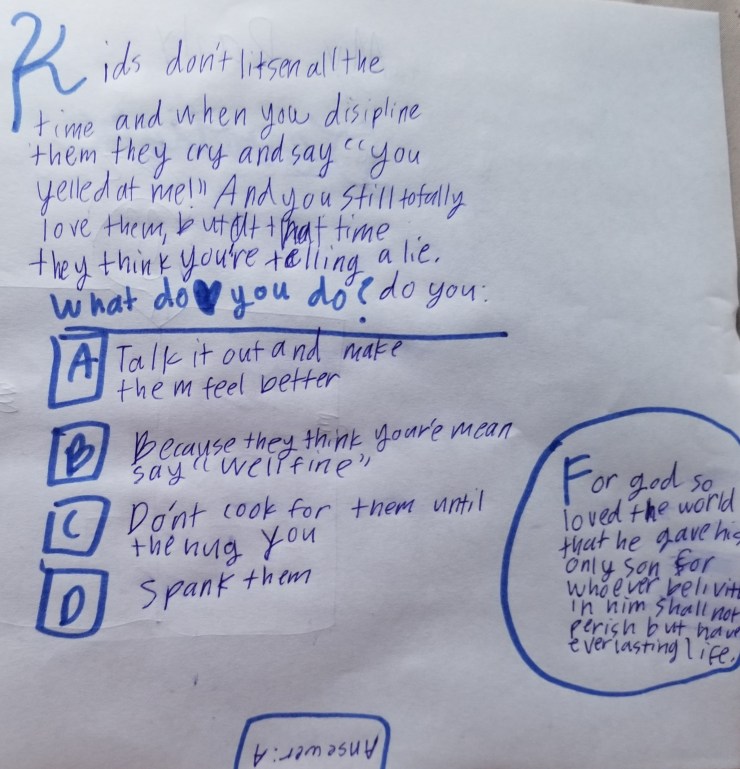
This morning after discussing our morning devotional together as a family, my wife shared with me that my daughter Mia decided (totally unprompted and on her own) that she is going to begin writing her own book of devotionals:

She wrote:

Kids don’t listen and when you discipline them, they cry and say, “You yelled at me!” And you still totally live them, but at that time, they think you ate telling a lie.

What do you do?

A) Talk it out and make them feel better

B) Because they think you ate mean, say “well fine!”

C) Don’t cook for them until they hug you

D) Spank them

For God so loved the world that He gave His only son for whoever believe in him shall not perish but have everlasting life.

(Answer: A)

What a beautiful thing to see my young daughter eager to share the Word and the Way in such a way this morning. It really blessed me this morning so much!

My first thought when reading her devotional as a parent was to recognize that something the parent has done has provoked their child to the point of not trusting them anymore in that moment.

As a parent, it is good to understand both sides of this complex topic of discipline.

Discipline is absolutely necessary and is good. Our children desperately need discipline to teach them how to avoid dangerous consequences in this life and how to choose the right way:

A youngster’s heart is filled with foolishness, but physical discipline will drive it far away.
Proverbs 22:15 NLT

By nature, children start out with neither experience nor instruction to lead them through this life, and they will make foolish and uninformed decisions without our help and guidance. If a child tries to pull a pot of hot water down from the stovetop because they know no better, it is good to correct them with a physical pop on their bottoms when they are young to teach them “No” and about danger and consequences. Physical discipline along more verbal explanations/discussions and physical punishment/restrictions as they grow older is not mean, but is loving.

Don’t fail to discipline your children. The rod of punishment won’t kill them. Physical discipline may well save them from death. My child, if your heart is wise, my own heart will rejoice!
Proverbs 23:13‭-‬15 NLT

So in the devotional Mia provided, she acknowledged that discipline is not enjoyable when it happens. Children do not like to be corrected in the moment that or is happening (nor do adults):

No discipline is enjoyable while it is happening—it’s painful! But afterward there will be a peaceful harvest of right living for those who are trained in this way.
Hebrews 12:11 NLT

And Ephesians 6:4 says, “Fathers, do not provoke your children to anger, but bring them up in the discipline and instruction of the Lord” while Colossians 3:21 echoes “Fathers, do not provoke your children, lest they become discouraged.”

As parents, we need to value and protect our ability to speak into our children’s lives. We need to understand that they will react to the necessary discipline that we provide, and that we need not avoid discipline or we will coddle them while not protecting them from farmer or teach them about consequences — and end up with the terror of a toddler’s “mine, mine, mine” mindset running around in an adult’s body eventually.

But we also need to avoid provoking or children to the point that we lose their trust. This necessary moment of discipline where it is not enjoyable to them opens the door for the enemy to step in and tell them they can’t trust us, saying things like, “If they loved you, they wouldn’t hurt you.” So we must be watchful and prayerfully prepared and ready to explain why discipline is necessary — we must use this opportunity to strengthen their trust by sharing the Truth behind why discipline was necessary.

A great way to do this is to know the applicable Word of God or know how to look it up and share with them what God has to say on the subject.

Now, adults, how many times have you recently been feeling the pain, the discipline, the consequences of your own decisions that resulted in the discipline of the Lord — and because it was difficult, you too listened to the lies of the enemy telling you that you couldn’t trust the Lord. The trick is the same for you as well — so don’t be surprised that your own children don’t always understand and trust when you yourself don’t either.

So let’s be willing to receive discipline when necessary, willing to apply discipline when necessary, and always seeking to keep the lines of communication open.

Lord, help us in these things to see and understand and choose your way. Amen.