Do we want a part in God’s ways?

When Job talks about the wicked wanting no part in God’s ways:

Job 21:14 NLT
And yet they say to God, ‘Go away. We want no part of you and your ways.

I’m reminded of Amos 5 where God says He wants no part of the people who are saying they long for the day of the Lord and who are outwardly religious with the hypocrisy and show:

Amos 5:18, 21-23 NLT
What sorrow awaits you who say, “If only the day of the Lord were here!” You have no idea what you are wishing for. That day will bring darkness, not light.
“I hate all your show and pretense— the hypocrisy of your religious festivals and solemn assemblies. I will not accept your burnt offerings and grain offerings. I won’t even notice all your choice peace offerings. Away with your noisy hymns of praise! I will not listen to the music of your harps.

And then reminded of Matthew 7:

Matthew 7:21-23 NLT
“Not everyone who calls out to me, ‘Lord! Lord!’ will enter the Kingdom of Heaven. Only those who actually do the will of my Father in heaven will enter. On judgment day many will say to me, ‘Lord! Lord! We prophesied in your name and cast out demons in your name and performed many miracles in your name.’ But I will reply, ‘I never knew you. Get away from me, you who break God’s laws.’

In Job 21, Job speaks truths about how God does allow the wicked to prosper in this life, then Eliohaz makes personal accusations of Job. Job doesn’t have to be a prophet to know that these “friends of his” aren’t there to comfort him but to mock him:

Job 21:2-3 NLT
“Listen closely to what I am saying. That’s one consolation you can give me. Bear with me, and let me speak. After I have spoken, you may resume mocking me.

And that’s exactly what happens:

Job 22:4-7 NLT
Is it because you’re so pious that he accuses you and brings judgment against you? No, it’s because of your wickedness! There’s no limit to your sins. “For example, you must have lent money to your friend and demanded clothing as security. Yes, you stripped him to the bone. You must have refused water for the thirsty and food for the hungry.

Accusations and casting stones at a suffering, grieving and devastated man because he isn’t putting on a show of public religion, offerings, and noisy praise but he’s being real about his situation.

What strikes me as fearful in this whole transaction isn’t anything truthful Job has said about God but how Eliahaz makes the mistake of presuming about God by essentially saying “If you do _____, God WILL  do ______.”

Job 22:29 NLT
If people are in trouble and you say, ‘Help them,’ God will save them.

This is such a wrong and frightening perspective and misunderstanding of God. We cannot use the Word of God to pin God into doing what we want — He is not our genie to command. It is not us who command things into existence from nothing. We are not witches, trying to figure out the right combination of words, potions, or actions we can take that will give us our intended results. God does as He pleases.

Psalms 115:3 NLT
Our God is in the heavens, and he does as he wishes.

Job is clearly aware of this truth, even as he seeks an opportunity to wrestle with God who he loves so deadly and has walked with his whole life:

Job 23:12-14 NLT
I have not departed from his commands, but have treasured his words more than daily food. But once he has made his decision, who can change his mind? Whatever he wants to do, he does. So he will do to me whatever he has planned. He controls my destiny.

You see,  Job knows that even walking close with God does not guarantee that we will not suffer, that we will not grieve,  that we will not face mocking and ridicule. In fact,  Jesus tells us that such things in the Kingdom of God are where the blessings are:

Matthew 5:3-12 NLT
“God blesses those who are poor and realize their need for him, for the Kingdom of Heaven is theirs. God blesses those who mourn, for they will be comforted. God blesses those who are humble, for they will inherit the whole earth. God blesses those who hunger and thirst for justice, for they will be satisfied. God blesses those who are merciful, for they will be shown mercy. [8] God blesses those whose hearts are pure, for they will see God. God blesses those who work for peace, for they will be called the children of God. God blesses those who are persecuted for doing right, for the Kingdom of Heaven is theirs. “God blesses you when people mock you and persecute you and lie about you and say all sorts of evil things against you because you are my followers. Be happy about it! Be very glad! For a great reward awaits you in heaven. And remember, the ancient prophets were persecuted in the same way.

Even a child can answer in their heart whether it would be a better to get that you and love their mother or lose the toy but have mother there to hold them and make it better. If we know this to be true about our earthly mother, we should definitely learn this lesson about our heavenly Father as well.

In all of this Job is not turning his back on God and dying (like his foolish wife suggested he do), but He is seeking God. In fact,  He knows that God’s testing in this life refines us:

Job 23:2-10 NLT
“My complaint today is still a bitter one, and I try hard not to groan aloud. If only I knew where to find God, I would go to his court. I would lay out my case and present my arguments. Then I would listen to his reply and understand what he says to me. Would he use his great power to argue with me? No, he would give me a fair hearing. Honest people can reason with him, so I would be forever acquitted by my judge. I go east, but he is not there. I go west, but I cannot find him. I do not see him in the north, for he is hidden. I look to the south, but he is concealed. “But he knows where I am going. And when he tests me, I will come out as pure as gold.

Isn’t it wild how loud our flesh can scream out at us to avoid the refining fires? Even how strongly Jesus’s flesh cried out to Him in  Gethsemane:

Luke 22:41-44 NLT
He walked away, about a stone’s throw, and knelt down and prayed, “Father, if you are willing, please take this cup of suffering away from me. Yet I want your will to be done, not mine.” Then an angel from heaven appeared and strengthened him. He prayed more fervently, and he was in such agony of spirit that his sweat fell to the ground like great drops of blood.

When we are at these points of the story,  Job arguing with his friends. Jesus in Gethsemane, a mother burying her dead child, a husband and wife hearing the word “cancer” from a doctor, a person dealing with chronic illness, a person struggling deeply with mental illness — do we seek God to wrestle with Him, or do we curse Him and  die?

Do we wisely want a part in God’s ways, or do we foolishly expect He will play a part in ours?

The only way is surrender, is turning to Him.

What a waste!

Imagine someone who lived ruthlessly building up wealth and possessions but who never took the time to enjoy them before having a heart attack and dying from all of the stress.

Imagine a child who sees his parent’s wealth, and who begrudgingly dotes on them (expecting an inheritance), yet they outlive him.

Imagine someone who grumbles about everything around them, and never takes the time to see and celebrate what is good and beautiful around them — and even worse, never takes any action towards improving the source of their own complaints.

Imagine someone who is so confident in what they believe personally that they are unwilling to examine it critically, to test their beliefs, to learn, to change and to grow.

Imagine a race horse with champion’s blood flowing through its veins that he up on a pig farm where he only knew to mimic those animals who lay around in the mud, eating and getting fat.

We can imagine stories like this and possibly think to ourselves “how foolish”, or “how silly”, or “what a waste!”

But how many times do we let ambition, or envy, or negativity, or pride, or distraction, or our own personal choice of thief — steal from what would be best?

If we found out right now that today would be our last day alive, what would fall off our calendar and off of our list of concerns — and what would be revealed as what is truly important?

It’s easy to hear this and nod our heads, acting as is it is good advice — but what if we actually walk through the exercise as if we believed it was good and helpful?

What on my priorities list needs to shift?

What have I allowed to set up shop in my mind as a focus that needs to be spot out of the way for what is truly important?

What changes should I be making to set my direction on what is best rather than allowing in what is familiar, comfortable, or is good enough?

I believe (and life has repeatedly taught me) that God wants the best for His children. For a long time, I misunderstood His wise advice and guidance as strict rules to either live up to or to fall short of — to either prove myself worthy or unworthy of His love. But that IS NOT the gospel of Jesus Christ — nor is it the wise and best way to approach a relationship and understanding of our relationship with God.

As a father, I don’t want to just be a lecturer, a rule maker, and a disciplinarian to my daughter. But if I refuse to share wisdom, if I refuse to challenge her, I’d I refuse to offer her boundaries and correction, she will not know the difference between what is foolish and wise until so much has been wasted and stolen from her. I know this from the hard lessons life has taught this stubborn old man.

‭Luke‬ ‭12:13‭-‬21‬ ‭NLT‬
[13] Then someone called from the crowd, “Teacher, please tell my brother to divide our father’s estate with me.” [14] Jesus replied, “Friend, who made me a judge over you to decide such things as that?” [15] Then he said, “Beware! Guard against every kind of greed. Life is not measured by how much you own.” [16] Then he told them a story: “A rich man had a fertile farm that produced fine crops. [17] He said to himself, ‘What should I do? I don’t have room for all my crops.’ [18] Then he said, ‘I know! I’ll tear down my barns and build bigger ones. Then I’ll have room enough to store all my wheat and other goods. [19] And I’ll sit back and say to myself, “My friend, you have enough stored away for years to come. Now take it easy! Eat, drink, and be merry!”’ [20] “But God said to him, ‘You fool! You will die this very night. Then who will get everything you worked for?’ [21] “Yes, a person is a fool to store up earthly wealth but not have a rich relationship with God.”

https://bible.com/bible/116/luk.12.13.NLT

Lord, you see past all of the stumbling blocks and distractions to what is truly best. You have good in store for us and not evil. Help us to trust, to listen, to hear, to see, to follow, to walk with you. Show us how even what seemed like a waste has a purpose in leading us forward. Help us give up and lay down any foolishness that would hinder us running out race today. Amen.

The Thief on the Cross

People like the thief on the cross (who did NOTHING BUT BELIEVE but was promised paradise), and Samson (who COMMITTED SUICIDE yet is listed in the Hebrews Hall of Faith) blast holes in many folks’ theology and religious dogma. Or at least all of the “imperfect people” in scripture makes them have to dance hilariously to try and make it fit into the rulebooks they have chosen as idols (in trade for their laying down the grace of God and trampling upon the precious Blood of the Lamb).

So it seems important that we understand and avoid those same mistakes ourselves!

I saw the following “copy pasta” on social media this morning (anonymous social media postings are ALWAYS SUSPECT but many times are worthy of contemplation):

“How does the thief on the cross fit into your theology? No baptism, no communion, no confirmation, no speaking in tongues, no mission trip, no volunteerism, and no church clothes. He couldn’t even bend his knees to pray. He didn’t say the sinner’s prayer and among other things, he was a thief. Jesus didn’t take away his pain, heal his body, or smite the scoffers. Yet it was a thief who walked into heaven the same hour as Jesus simply by believing. He had nothing more to offer other than his belief that Jesus was who he said he was. No spin from brilliant theologians. No ego or arrogance. No Shiny lights, skinny jeans, or crafty words. No haze machine, donuts, or coffee in the entrance. Just a naked dying man on a cross unable to even fold his hands to pray.”
For God so loved the world he gave his only begotten son so that whosoever believed in him would not perish but have everlasting life. John 3:16
I read this today and was reminded of the simplicity of the Gospel.
Copied from a Friend.

It reminds me of a recent conversation that I had with my aunt about Jesus, about salvation, about judgement, and about faith. No matter how I tried to introduce her to the concept of grace, she refused to accept it and would ask another, “Well if I do _____ is that going to be good enough to get into heaven?”

Ephesians chapter 2 is a great scripture for tearing down people’s religious theology that has God constantly “changing the rules” on what they “must do to prove themselves a Christian”. I suggest you correct anyone who places the requirements for your salvation on anything more than God’s grace to draw you and give you the gift of faith.

For it is by grace [God’s remarkable compassion and favor drawing you to Christ] that you have been saved [actually delivered from judgment and given eternal life] through faith. And this [salvation] is not of yourselves [not through your own effort], but it is the [undeserved, gracious] gift of God;
Ephesians 2:8 AMP

God saved you by his grace when you believed. And you can’t take credit for this; it is a gift from God. Salvation is not a reward for the good things we have done, so none of us can boast about it. For we are God’s masterpiece. He has created us anew in Christ Jesus, so we can do the good things he planned for us long ago.
Ephesians 2:8‭-‬10 NLT

Now God has us where he wants us, with all the time in this world and the next to shower grace and kindness upon us in Christ Jesus. Saving is all his idea, and all his work. All we do is trust him enough to let him do it. It’s God’s gift from start to finish! We don’t play the major role. If we did, we’d probably go around bragging that we’d done the whole thing! No, we neither make nor save ourselves. God does both the making and saving. He creates each of us by Christ Jesus to join him in the work he does, the good work he has gotten ready for us to do, work we had better be doing. But don’t take any of this for granted. It was only yesterday that you outsiders to God’s ways had no idea of any of this, didn’t know the first thing about the way God works, hadn’t the faintest idea of Christ. You knew nothing of that rich history of God’s covenants and promises in Israel, hadn’t a clue about what God was doing in the world at large. Now because of Christ—dying that death, shedding that blood—you who were once out of it altogether are in on everything.
Ephesians 2:7‭-‬13 MSG

The account of the thief is here in the book of Luke:

Two others, both criminals, were led out to be executed with him. When they came to a place called The Skull, they nailed him to the cross. And the criminals were also crucified—one on his right and one on his left. Jesus said, “Father, forgive them, for they don’t know what they are doing.” And the soldiers gambled for his clothes by throwing dice. The crowd watched and the leaders scoffed. “He saved others,” they said, “let him save himself if he is really God’s Messiah, the Chosen One.” The soldiers mocked him, too, by offering him a drink of sour wine. They called out to him, “If you are the King of the Jews, save yourself!” A sign was fastened above him with these words: “This is the King of the Jews.” One of the criminals hanging beside him scoffed, “So you’re the Messiah, are you? Prove it by saving yourself—and us, too, while you’re at it!” But the other criminal protested, “Don’t you fear God even when you have been sentenced to die? We deserve to die for our crimes, but this man hasn’t done anything wrong.” Then he said, “Jesus, remember me when you come into your Kingdom.” And Jesus replied, “I assure you, today you will be with me in paradise.”
Luke 23:32‭-‬43 NLT

If your theology rests upon the precious Blood of the Lamb, upon Christ alone as the justification — and the gift of grace through faith as the salvation — you have nothing but a response of gratitude to lead you along this narrow path holding His hand as He leads you. This is the gospel.

If your theology REQUIRES OF YOU (checking off a list of requirements/rules) — instead of TESTIFIES OF GOD’S GRACE — it probably has left the narrow path. Let what He has done be what PRODUCES INSIDE YOU the good work. That isn’t the same as doing good works trying to prove or earn something.

God bless!

Who have you invited?

Who we invite says a lot about us.

Then at the resurrection of the righteous, God will reward you for inviting those who could not repay you.”
Luke 14:14 NLT

The natural man understands these three things:

  • Inviting rich and respected people who can pay him a good return on his investment in inviting them
  • Inviting those very much like himself in appearance, standing, opinions, and passions to build support for his own causes
  • Inviting a poor man as long as his display of pity towards the man can be applauded and praised

But what about the man whose heart for them drives him to invite just as easily the poor, the crippled, the lame, the blind, the rich, the comfortable, the healthy, and all men of all walks of life?

Could we say that such a spiritual man was just, and impartial, and kind, and humble — and might have a glimpse at what great value lies beneath the varied outward coverings in every case?

Might we do well ourselves to lay down those familiar traditions and perspectives — and turn away from those old, natural ways of invitation contrived for the means of manipulations and exclusions?

Lord, help us to see your example of grace and mercy — giving us what we could not earn nor could we ever repay. Help us treasure this in our hearts and be molded and shaped to be more like you. Amen.

Who do we “seek the best or highest good for”?

This morning’s YouVersion Bible app “Verse of the Day” is:

But love [that is, unselfishly seek the best or higher good for] your enemies, and do good, and lend, expecting nothing in return; for your reward will be great (rich, abundant), and you will be sons of the Most High; because He Himself is kind and gracious and good to the ungrateful and the wicked.
Luke 6:35 AMP

And the second word of this verse in most English translations is “love” (ἀγαπᾶτε in the Greek that sounds like “agapao”) — which is a verb, in the present active imperative, second person plural tense. It is an instruction given by Jesus to a multitude of disciples that is also given to us.

In fact, He even explains later that all of the law and all of the words of the prophets are built upon this — “love”.

And I especially like how the Amplified version expands this out in their translation in perfect “ELI5” form (“ELI5” = “Explain like I’m 5”). With the bracketed note “[that is, unselfishly seek the best or highest good for]” that they point towards “your enemies” in the gospel way that is shocking and offensive to our ego and carnal sensibilities.

You want to hear from God? He instructs you, commands you to seek the best and highest good — not for yourself, not for those who love you, not for those who are good in your eyes, but for your enemies.

Yep, this is where the rubber meets the road, where true saving faith is revealed, where most of us must count the true cost of Discipleship. And we must truly decide whether we will lay down those heavy burdens of offense, of unforgiveness, of grudges, of longing for revenge, of accusing others, or judging others — to pick up our cross and follow Jesus. It isn’t whether we will go to church, or graduate seminary, or preach publicly, or cross streets and oceans to win religious converts, or post scripture and encouragement online. It is whether we will seek the best for them — not just hope or wish or want for these enemies the best things — but to be active in seeking it on their behalf.

Can we admit that in our flesh, that is quite unnatural?

Can we lay down our religious coverings, and instead bear naked and fully exposed the desires of our hearts — and honestly admit that “enemy” that we have been clinging to so strongly that we cannot grasp a firm hold upon the grace available to us because of the cross?

Yes, this gospel is about surrendering our own demands so that through faith in God’s plan and purpose, we can trust that love and forgiveness is the cure that we need for the disease that was killing us. Yes, it sets us free from “enemies” holding our hearts captive in unforgiveness — to us soaring and seeking the best for those same people who are beloved by God.

Are our eyes open to see that those we once deemed “enemies” are now “beloved”?

If this is a heavy burden, realize that if we measure them by what they have done, we will be measured by what we have done, and that is a long spiral down into the pit of hell. It will crush our opportunities today by taking our hearts and minds captive to a cell and shackles that only imprisons and hurts us, not them.

To know what we should do and not do it is sin, and the wages of sin is death. He says we should seek the best and highest good for them.

Decide now…

We will go out today to live amongst the world, but we mustn’t be content with living as they do, “Christian”. Let’s not take the name of the Lord in vain by claiming the name like a cheap costume at Halloween, but leaving the one call that would truly let the world see God in us and would truly give Him glory. Amen.

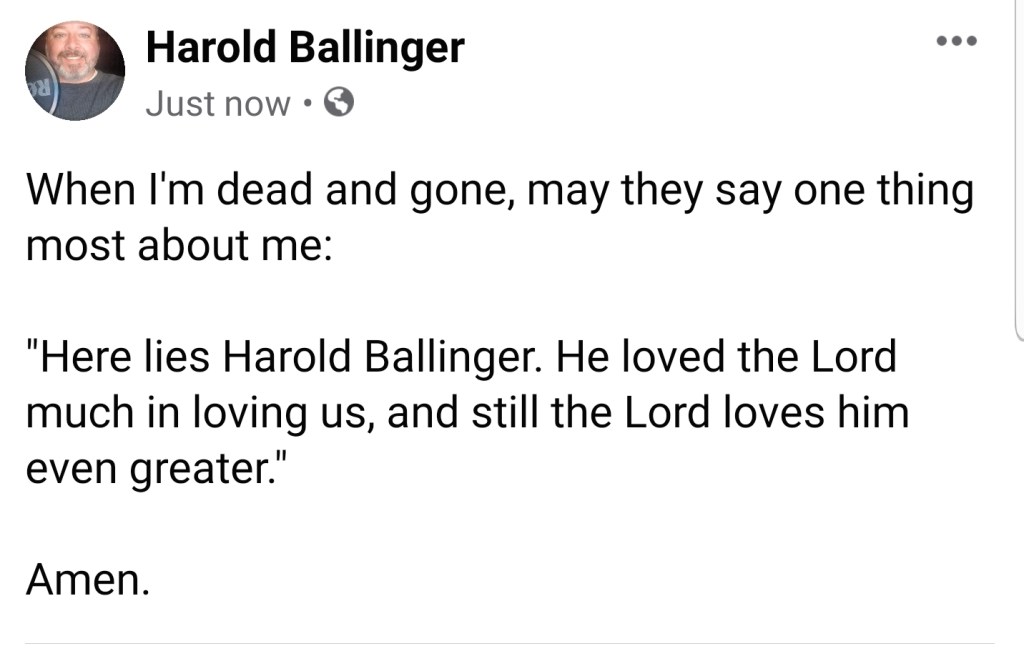
Epitaph

This morning, I’m reminded that my love for you is my love for the Lord.

Not my studying and digesting and understanding and teaching the Word of God like a good theologian.

Not my defending the Word of God through debate and reason like a good apologist.

Not my singing and praising with voice and instrument like a good worshiper.

Not my touching and healing or casting out evil spirits by the Word of God like a good healer.

Not my speaking prayers with the tongues of angels and tears and pains of heartfelt concern for the needs of others like a good intercessor.

Not my revealing God’s will and bringing a timely and convicting message to the people of God like a good prophet.

Not my delivering the Roman road gospel explanation and offering an altar call for response and baptizing many in the name of the Lord like a good evangelist.

Not my feeding and providing for the needs of others like a good philanthropist.

These things alone can become tasks, checklists, routines, practices — dead religion and self- righteous hypocrisy.

But love.

Love makes all the difference.

I love you.

He loves you.

In all the things we will do today, we will show others how much we love them:

  • By our respect or our disrespect
  • By our presence or our absence
  • By our gentleness or our harshness
  • By our selflessness or our demands
  • By our patience or our impatience
  • By our joy or our anxiousness
  • By our forgiveness or our bitterness
  • By our making peace or our opposition
  • By our self-control or our attempts to control others

And the world is in desperate need of love. People are even turning their backs in droves from “the usual religious places” because they are not finding love there — they are looking for Jesus — and are understandably doubtful that He is there amongst all this activity and practice, but where there is so little love.

So let us set our sights on living others, Christian, beloved of God — because they truly are beloved by God. Ands out is our job to show that love to them in the language and manner they can see and understand is real.

Go love greatly! Because we are greatly loved!

Amen.

The story of Mary and Martha immediately following the golden rule in Luke 10 is not by coincidence:

And he replied, “You shall love the Lord your God with all your heart , and with all your soul , and with all your strength , and with all your mind ; and your neighbor as yourself .” Jesus said to him, “You have answered correctly; do this habitually and you will live .” But he, wishing to justify and vindicate himself, asked Jesus, “And who is my neighbor?” Jesus replied, “A man was going down from Jerusalem to Jericho, and he encountered robbers, who stripped him of his clothes [and belongings], beat him, and went their way [unconcerned], leaving him half dead. Now by coincidence a priest was going down that road, and when he saw him, he passed by on the other side. Likewise a Levite also came down to the place and saw him, and passed by on the other side [of the road]. But a Samaritan (foreigner), who was traveling, came upon him; and when he saw him, he was deeply moved with compassion [for him], and went to him and bandaged up his wounds, pouring oil and wine on them [to sooth and disinfect the injuries]; and he put him on his own pack-animal, and brought him to an inn and took care of him. On the next day he took out two denarii (two days’ wages) and gave them to the innkeeper, and said, ‘Take care of him; and whatever more you spend, I will repay you when I return.’ Which of these three do you think proved himself a neighbor to the man who encountered the robbers?” He answered, “The one who showed compassion and mercy to him.” Then Jesus said to him, “Go and constantly do the same.” Now while they were on their way, Jesus entered a village [called Bethany], and a woman named Martha welcomed Him into her home. She had a sister named Mary, who seated herself at the Lord’s feet and was continually listening to His teaching. But Martha was very busy and distracted with all of her serving responsibilities; and she approached Him and said, “Lord, is it of no concern to You that my sister has left me to do the serving alone? Tell her to help me and do her part.” But the Lord replied to her, “Martha, Martha, you are worried and bothered and anxious about so many things; but only one thing is necessary, for Mary has chosen the good part [that which is to her advantage], which will not be taken away from her.”
Luke 10:27‭-‬42 AMP

Bodies and Cars and Love by the Wayside

Ever been driving on a cold, rainy morning — and see a body off the side of the road, face down in the grass, not moving?

I did this morning.

FaceDownGrass

And even as I continued by and watched in my rear view mirror, I knew what I had to do. Even though my fuel gauge was on empty, even though I was going to be late for work, even though my phone was dead and I had no way of calling 911 — so many reasons to let someone else handle it — but I knew that I had to go back.

As I turned the car around and headed back, I wondered to myself, “What am I even going to do if this guy is dead and not just passed out?”

But imagine my surprise when he was surprised by my approach and my loud shout of, “Is everything okay?” Imagine my surprise when what I thought was either a dead body or a passed out drunk — responded alert and quite as much surprised by my unexpected presence in his morning, as I was about his presence in mine.

I then realized that he had been laying on his face, motionless with his right arm (that I thought was beneath him) actually down some type of hole or pipe and he was doing some type of utility work with his hand deep in the ground.

“Sorry, I just wasn’t sure if everything was okay,” I stammered as I stopped short and made it clear to him that I wasn’t approaching as a threat but as a concerned neighbor.

I don’t know if he laughed or exactly what he said, but we both realized the humor of each other’s side of the situation for a moment — we had both for that split moment looked at the situation from how the other was seeing it — him seeing a guy who thought he was about to deal with a body on the side of the road — and me seeing a guy just trying to start his dirty morning work to have a stranger come up from behind and scare him.

I said, “God bless” and headed back on my way to work.

But it got me thinking — how many times do we see metaphorical “dead or hurt bodies along the ditches of this life through which we are walking” and choose to do nothing about it?

And how many times might we think that we’re about to help someone who is in trouble to realize that they are just fine and don’t actually need our help?

Do we even stop to find out?

I’m not saying that to glorify the fact that I stopped this time, because there are many times that not only did I not stop to help my brother or sister in need, I didn’t really care about them because “I had my own things to worry about.”


Let’s look at it from a different angle too…

I spent time with a friend who drives a wrecker early, early this morning for the second Thursday morning in a row where he was picking up a car from the side of the road. Last week it was a vehicle that had flipped and rolled over multiple times. This week it was a vehicle that had been stolen and recovered by the police. In the first case, the occupants of the car wanted and needed help. The occupant of the car this time needed help but definitely didn’t want the help he found by way of the back seat of a police car.

But even though we might see the parallels and connections up to this point, I want to bring out something that Nickey (that’s my friend who drives the wrecker) mentioned while we were riding in that roll back wrecker early this morning.

He said, “Hop, you know how some folks are quick to hug and tell each other they love each other?”

“Yes,” I replied.

He said, “I don’t do that, because I think that the English language does a disservice to that word love. There is only one word for ‘love’ in English, but in Hebrew and Greek and many other languages they have different words to describe the actual thing they are talking about.”

“I understand what you’re saying. People can say ‘love’ and mean all kinds of things in English — passion, intimacy, deep brotherly love, superficial love, like, lust — all kinds of things,” I replied.

He continued, “If I ask you to help me with something and you tell me that you’re too busy, what are you really saying?”

I understood his line of questioning immediately. I answered, “I’m saying that I care more about what I have planned or want to do.”

“And that speaks to what you truly love, right?” Nickey prompted and then quickly mentioned, “You remember when I asked you a few weeks ago about us getting together with our wives for dinner sometime?”

Boom! Bomb dropped in love. Correction accepted. I love this man, this friend, this brother.

Here I thought we were having a Luke 10:25-37, Parable of the Good Samaritan, conversation. And we were passing through that “town” of love, but the “street address” that Nickey was looking for as we rode along in that flatbed wrecker together was John 13:35.

I spoke with my wife this morning. We’ll be doing dinner with Nickey and his wife next week.


John 13:34-35 (NLT)

34 So now I am giving you a new commandment: Love each other. Just as I have loved you, you should love each other. 35 Your love for one another will prove to the world that you are my disciples.”


Luke 10:25-37 (NLT)

The Most Important Commandment

25 One day an expert in religious law stood up to test Jesus by asking him this question: “Teacher, what should I do to inherit eternal life?”

26 Jesus replied, “What does the law of Moses say? How do you read it?”

27 The man answered, “‘You must love the Lord your God with all your heart, all your soul, all your strength, and all your mind.’ And, ‘Love your neighbor as yourself.’”

28 “Right!” Jesus told him. “Do this and you will live!”

29 The man wanted to justify his actions, so he asked Jesus, “And who is my neighbor?”

Parable of the Good Samaritan

30 Jesus replied with a story: “A Jewish man was traveling from Jerusalem down to Jericho, and he was attacked by bandits. They stripped him of his clothes, beat him up, and left him half dead beside the road.

31 “By chance a priest came along. But when he saw the man lying there, he crossed to the other side of the road and passed him by. 32 A Temple assistant walked over and looked at him lying there, but he also passed by on the other side.

33 “Then a despised Samaritan came along, and when he saw the man, he felt compassion for him. 34 Going over to him, the Samaritan soothed his wounds with olive oil and wine and bandaged them. Then he put the man on his own donkey and took him to an inn, where he took care of him. 35 The next day he handed the innkeeper two silver coins,[c] telling him, ‘Take care of this man. If his bill runs higher than this, I’ll pay you the next time I’m here.’

36 “Now which of these three would you say was a neighbor to the man who was attacked by bandits?” Jesus asked.

37 The man replied, “The one who showed him mercy.”

Then Jesus said, “Yes, now go and do the same.”

[Mia, Daddy & Friends] “Preparing the Way”


Luke 3:1-22 (NLT)

John the Baptist Prepares the Way

It was now the fifteenth year of the reign of Tiberius, the Roman emperor. Pontius Pilate was governor over Judea; Herod Antipas was ruler[a] over Galilee; his brother Philip was ruler[b] over Iturea and Traconitis; Lysanias was ruler over Abilene. Annas and Caiaphas were the high priests. At this time a message from God came to John son of Zechariah, who was living in the wilderness. Then John went from place to place on both sides of the Jordan River, preaching that people should be baptized to show that they had repented of their sins and turned to God to be forgiven. Isaiah had spoken of John when he said,

“He is a voice shouting in the wilderness,
‘Prepare the way for the Lord’s coming!
    Clear the road for him!
The valleys will be filled,
    and the mountains and hills made level.
The curves will be straightened,
    and the rough places made smooth.
And then all people will see
    the salvation sent from God.’”[c]

When the crowds came to John for baptism, he said, “You brood of snakes! Who warned you to flee the coming wrath? Prove by the way you live that you have repented of your sins and turned to God. Don’t just say to each other, ‘We’re safe, for we are descendants of Abraham.’ That means nothing, for I tell you, God can create children of Abraham from these very stones. Even now the ax of God’s judgment is poised, ready to sever the roots of the trees. Yes, every tree that does not produce good fruit will be chopped down and thrown into the fire.”

10 The crowds asked, “What should we do?”

11 John replied, “If you have two shirts, give one to the poor. If you have food, share it with those who are hungry.”

12 Even corrupt tax collectors came to be baptized and asked, “Teacher, what should we do?”

13 He replied, “Collect no more taxes than the government requires.”

14 “What should we do?” asked some soldiers.

John replied, “Don’t extort money or make false accusations. And be content with your pay.”

15 Everyone was expecting the Messiah to come soon, and they were eager to know whether John might be the Messiah. 16 John answered their questions by saying, “I baptize you with[d] water; but someone is coming soon who is greater than I am—so much greater that I’m not even worthy to be his slave and untie the straps of his sandals. He will baptize you with the Holy Spirit and with fire.[e] 17 He is ready to separate the chaff from the wheat with his winnowing fork. Then he will clean up the threshing area, gathering the wheat into his barn but burning the chaff with never-ending fire.” 18 John used many such warnings as he announced the Good News to the people.

19 John also publicly criticized Herod Antipas, the ruler of Galilee,[f] for marrying Herodias, his brother’s wife, and for many other wrongs he had done. 20 So Herod put John in prison, adding this sin to his many others.

The Baptism of Jesus

21 One day when the crowds were being baptized, Jesus himself was baptized. As he was praying, the heavens opened, 22 and the Holy Spirit, in bodily form, descended on him like a dove. And a voice from heaven said, “You are my dearly loved Son, and you bring me great joy.[g]

[Mia, Daddy & Friends] “Never Leave”


The Prophecy of Anna

36 Anna, a prophet, was also there in the Temple. She was the daughter of Phanuel from the tribe of Asher, and she was very old. Her husband died when they had been married only seven years. 37 Then she lived as a widow to the age of eighty-four.[c]She never left the Temple but stayed there day and night, worshiping God with fasting and prayer. 38 She came along just as Simeon was talking with Mary and Joseph, and she began praising God. She talked about the child to everyone who had been waiting expectantly for God to rescue Jerusalem.

39 When Jesus’ parents had fulfilled all the requirements of the law of the Lord, they returned home to Nazareth in Galilee.40 There the child grew up healthy and strong. He was filled with wisdom, and God’s favor was on him.

[Mia, Daddy & Friends] “What are we waiting for?”


The Prophecy of Simeon

25 At that time there was a man in Jerusalem named Simeon. He was righteous and devout and was eagerly waiting for the Messiah to come and rescue Israel. The Holy Spirit was upon him 26 and had revealed to him that he would not die until he had seen the Lord’s Messiah. 27 That day the Spirit led him to the Temple. So when Mary and Joseph came to present the baby Jesus to the Lord as the law required, 28 Simeon was there. He took the child in his arms and praised God, saying,

29 “Sovereign Lord, now let your servant die in peace,
    as you have promised.
30 I have seen your salvation,
31     which you have prepared for all people.
32 He is a light to reveal God to the nations,
    and he is the glory of your people Israel!”

33 Jesus’ parents were amazed at what was being said about him. 34 Then Simeon blessed them, and he said to Mary, the baby’s mother, “This child is destined to cause many in Israel to fall, and many others to rise. He has been sent as a sign from God, but many will oppose him. 35 As a result, the deepest thoughts of many hearts will be revealed. And a sword will pierce your very soul.”