
A final word: Be strong in the Lord and in his mighty power. Put on all of God’s armor so that you will be able to stand firm against all strategies of the devil. For we are not fighting against flesh-and-blood enemies, but against evil rulers and authorities of the unseen world, against mighty powers in this dark world, and against evil spirits in the heavenly places. Therefore, put on every piece of God’s armor so you will be able to resist the enemy in the time of evil. Then after the battle you will still be standing firm. Stand your ground, putting on the belt of truth and the body armor of God’s righteousness. For shoes, put on the peace that comes from the Good News so that you will be fully prepared. In addition to all of these, hold up the shield of faith to stop the fiery arrows of the devil. Put on salvation as your helmet, and take the sword of the Spirit, which is the word of God. Pray in the Spirit at all times and on every occasion. Stay alert and be persistent in your prayers for all believers everywhere. And pray for me, too. Ask God to give me the right words so I can boldly explain God’s mysterious plan that the Good News is for Jews and Gentiles alike. I am in chains now, still preaching this message as God’s ambassador. So pray that I will keep on speaking boldly for him, as I should.
Ephesians 6:10-20 NLT
https://bible.com/bible/116/eph.6.10-20.NLT

Letting go of a “Simple Man”
Last night was tough, and today will be challenging…

I’m going to be cleaning out the house tomorrow that I’ve always called home, no matter where I’ve lived.

We will be bagging stuff up to throw away, and gathering things to sell to people who have no idea the precious hands that touched and held and used these things — things that are all that is left of so many sweet memories.
I listened to and sang Simple Man by Skynyrd last night and it just broke me when I realized that I’m so much the opposite of that song. I’m so much the opposite of the “Simple Man” that he was.

I’ve spend so much of my life “chasing after the rich man’s gold” — pleasures and niceties — willing to use credit when I couldn’t yet afford something thinking that “I’ll pay for it later.” It’s stupid the traps we can get ourselves into — even when we think we are making wise and reasonable decisions — much worse when we are just being foolish, selfish and greedy.
I wish that I had just learned to live simple like Bill.
“Don’t buy it unless you can pay cash for it.”
“Take care of what you have.”
“Fix what you have instead of buying a new replacement.”
“Don’t rely on the big comforts, extravagant meals and entertainment and vacations — save and give generously and consistently — and learn to live off of less and appreciate the little things in life.”
He was the type of man that makes me ashamed of how little I can compare myself to him in those things that I admire most about him. I feel like I’ve let him down in almost every way that mattered to him.
Last night, as I wrestled with the anticipation of what would come today — I found myself sobbing, weeping, writhing on the floor, howling like a hurt animal. I couldn’t even lay in the bed, but preferred the cold, hard floor and the closet floor away from even my wife who was doing her best to be there for me and pray for me as I found myself brokenhearted before myself and before God.
The anticipation was killing me last night.
It’s like Mia said about riding Fury 325 at Carowinds — the worst part is the slow click, click, click as you are climbing the hill, waiting for the drop — the anticipation. The drop isn’t even as bad as the anticipation.

My mind just couldn’t seem to handle it last night. I just wanted to go somewhere, hide somewhere, escape to the woods or to the bottom of a bottle somewhere!
I know that’s horrible to say. I know that someone is going to say, “But doesn’t he talk about Jesus and now he’s talking about drinking?” I am tempted too– you can believe that! Sometimes my faith is hanging on by a thin thread, but even when I doubt and I fall on my face, He’s always pulled me back up before I drown.
So I cried out
“Lord, help me please!”
And I remembered and prayed:
The Lord is my shepherd, I shall not want. He leads me beside the still waters. He restores my soul. He leads me in the path of righteousness for His name’s sake. Though I walk through this valley, in the shadow of mourning Bill’s death, I will fear no evil. You are with me, and your discipline and your guidance comforts me. Even in the midst of my enemies who surround and attack me, you prepare a table for me. What they meant fir evil, you will turn to good. Your grace and mercy anoints me and my cup runs over with your blessings, Lord. Surely goodness and mercy will follow me all the days of my life, and I will dwell with you forever. Amen.
And I remembered the song lyrics:
I’ve stood on this stage night after night
Reminding the broken it’ll be alright
But right now, oh right now I just can’tIt’s easy to sing
When there’s nothing to bring me down
But what will I say
When I’m held to the flame
Like I am right nowI know You’re able and I know You can
Save through the fire with Your mighty hand
But even if You don’t
My hope is You aloneThey say it only takes a little faith
To move a mountain
Well, good thing
A little faith is all I have right now
But God, when You choose
To leave mountains unmovable
Give me the strength to be able to sing
It is well with my soul
Hoping that the last line of those lyrics would be true, I found a friend’s testimony about how her life has been filled with loss, but that the Lord has always been there for her:
I hope this helps someone. There is something in my life that I never seem to get use to. Losing the people I love. Around 5 my father left. He was abusive and drank. My mother never got over that. We lost her to depression and bipolar disorder. My oldest brother went to live with his biological father. This left me and my little two year old brother to really form a bond. We were both physically and emotionally abused. We moved a lot not making friends. The times we lived with our grandparents were the best. We had Nanny and Papa and Anita across the street. I never made friends in school. Kept to myself, always feeling out of place. I tried to commit suicide and spent 3 months in a comma. At age 12 I moved to Connie Maxwell Children’s Home. Didn’t make friends there easy either. I was use to adults and people older than I. I formed an amazing friendship with my houseparent “Ma”. My administrators were like parents. An old soul they called me. Had the same boyfriend for 6 1/2 years. We went to the same college and my world once again fell apart when we parted ways. I finished college in 3 1/2 years with a BA and two minors. No this girl didn’t party or have too much fun. Explains the nut I am now. LOL! Got married, divorced, very short marriage. Married again moved back home to Inman…..another broken heart. Once more 20 years later my very first boyfriend from Connie Maxwell and I married. Lost him to drugs, alcohol, abuse, and adultery. I almost lost my son to Leukemia, my little brother died in 2016..went to sleep and never woke up. My oldest brother called on the day of his celebration of life to let us know he would no longer have anything to do with me. Ma passed away. Dakota the baby I lost…his birthday is this month…the 16th. This is just part of my story….and not much detail. This life brings lots of pain and loss. I am so grateful that I have always known Jesus was with me. I use to talk to him when I was small. I called him my best friend. He still is till this day! No matter how many people leave, how much loss, how much pain, He will NEVER LEAVE MY SIDE!
So if I post a lot about my Savior! It is because he has saved me not only from eternal damnation! He has saved my life so many times on this earth! So many times my life should have ended but I have more time to serve my KING!
OUR FAMILY IS GRATEFULLY BLESSED
And I thanked her and she prayed for me, and I was finally able to calm down enough to return to bed.
This morning, I awoke to what the day has for me:

And the following scriptures prepared me for my day. The anticipation is over and the day is here:
To everything there is a season, A time for every purpose under heaven: A time to be born, And a time to die; A time to plant, And a time to pluck what is planted; A time to kill, And a time to heal; A time to break down, And a time to build up; A time to weep, And a time to laugh; A time to mourn, And a time to dance; A time to cast away stones, And a time to gather stones; A time to embrace, And a time to refrain from embracing; A time to gain, And a time to lose; A time to keep, And a time to throw away; A time to tear, And a time to sew; A time to keep silence, And a time to speak; A time to love, And a time to hate; A time of war, And a time of peace.
Ecclesiastes 3:1-8 NKJV
Blessed are those who mourn, For they shall be comforted.
Matthew 5:4 NKJV
The Lord hears his people when they call to him for help. He rescues them from all their troubles. The Lord is close to the brokenhearted; he rescues those whose spirits are crushed. The righteous person faces many troubles, but the Lord comes to the rescue each time.
Psalms 34:17-19 NLT
Praise the Lord ! How good to sing praises to our God! How delightful and how fitting! The Lord is rebuilding Jerusalem and bringing the exiles back to Israel. He heals the brokenhearted and bandages their wounds. He counts the stars and calls them all by name. How great is our Lord! His power is absolute! His understanding is beyond comprehension! The Lord supports the humble, but he brings the wicked down into the dust. Sing out your thanks to the Lord ; sing praises to our God with a harp. He covers the heavens with clouds, provides rain for the earth, and makes the grass grow in mountain pastures. He gives food to the wild animals and feeds the young ravens when they cry. He takes no pleasure in the strength of a horse or in human might. No, the Lord ’s delight is in those who fear him, those who put their hope in his unfailing love.
Psalms 147:1-11 NLT
Thank you, Heavenly Father! Thank you, Jesus! Thank you, Holy Spirit! You are always true and faithful, and your Word proves true time after time again.
Thank you, brothers and sisters in Christ, who are willing to share your testimonies, encourage each other, serve each other, pray for each other, and bear each other’s burdens.
Genuine, Direct Communication Squashes Assumptions and Gossip
Clear, honest communication and a willingness to listen, not just speak, clears up all kinds of problems — and prevents disaster. Assumptions, false accusations, gossip, and division will otherwise result in a hostile environment and war inside the camp.

But while they were still in Canaan, and when they came to a place called Geliloth near the Jordan River, the men of Reuben, Gad, and the half-tribe of Manasseh stopped to build a large and imposing altar. The rest of Israel heard that the people of Reuben, Gad, and the half-tribe of Manasseh had built an altar at Geliloth at the edge of the land of Canaan, on the west side of the Jordan River. So the whole community of Israel gathered at Shiloh and prepared to go to war against them. First, however, they sent a delegation led by Phinehas son of Eleazar, the priest, to talk with the tribes of Reuben, Gad, and the half-tribe of Manasseh. In this delegation were ten leaders of Israel, one from each of the ten tribes, and each the head of his family within the clans of Israel. When they arrived in the land of Gilead, they said to the tribes of Reuben, Gad, and the half-tribe of Manasseh, “The whole community of the Lord demands to know why you are betraying the God of Israel. How could you turn away from the Lord and build an altar for yourselves in rebellion against him? Was our sin at Peor not enough? To this day we are not fully cleansed of it, even after the plague that struck the entire community of the Lord . And yet today you are turning away from following the Lord . If you rebel against the Lord today, he will be angry with all of us tomorrow. “If you need the altar because the land you possess is defiled, then join us in the Lord ’s land, where the Tabernacle of the Lord is situated, and share our land with us. But do not rebel against the Lord or against us by building an altar other than the one true altar of the Lord our God. Didn’t divine anger fall on the entire community of Israel when Achan, a member of the clan of Zerah, sinned by stealing the things set apart for the Lord ? He was not the only one who died because of his sin.” Then the people of Reuben, Gad, and the half-tribe of Manasseh answered the heads of the clans of Israel: “The Lord , the Mighty One, is God! The Lord , the Mighty One, is God! He knows the truth, and may Israel know it, too! We have not built the altar in treacherous rebellion against the Lord . If we have done so, do not spare our lives this day. If we have built an altar for ourselves to turn away from the Lord or to offer burnt offerings or grain offerings or peace offerings, may the Lord himself punish us. “The truth is, we have built this altar because we fear that in the future your descendants will say to ours, ‘What right do you have to worship the Lord , the God of Israel? The Lord has placed the Jordan River as a barrier between our people and you people of Reuben and Gad. You have no claim to the Lord .’ So your descendants may prevent our descendants from worshiping the Lord . “So we decided to build the altar, not for burnt offerings or sacrifices, but as a memorial. It will remind our descendants and your descendants that we, too, have the right to worship the Lord at his sanctuary with our burnt offerings, sacrifices, and peace offerings. Then your descendants will not be able to say to ours, ‘You have no claim to the Lord .’ “If they say this, our descendants can reply, ‘Look at this copy of the Lord ’s altar that our ancestors made. It is not for burnt offerings or sacrifices; it is a reminder of the relationship both of us have with the Lord .’ Far be it from us to rebel against the Lord or turn away from him by building our own altar for burnt offerings, grain offerings, or sacrifices. Only the altar of the Lord our God that stands in front of the Tabernacle may be used for that purpose.” When Phinehas the priest and the leaders of the community—the heads of the clans of Israel—heard this from the tribes of Reuben, Gad, and the half-tribe of Manasseh, they were satisfied. Phinehas son of Eleazar, the priest, replied to them, “Today we know the Lord is among us because you have not committed this treachery against the Lord as we thought. Instead, you have rescued Israel from being destroyed by the hand of the Lord .” Then Phinehas son of Eleazar, the priest, and the other leaders left the tribes of Reuben and Gad in Gilead and returned to the land of Canaan to tell the Israelites what had happened. And all the Israelites were satisfied and praised God and spoke no more of war against Reuben and Gad. The people of Reuben and Gad named the altar “Witness,” for they said, “It is a witness between us and them that the Lord is our God, too.”
Joshua 22:10-34 NLT
We are to be peacemakers, not people eager to go to war — not eager to spread gossip based on assumptions and accusations that may be false.
Do you know what the Lord has told another man to do unless you ask them?
Would you have condemned and gossiped about Abraham if you saw him taking his son up the mountain to sacrifice him?
Do you know the heart of a man is or his underlying reasons unless you ask them?
Would you have gossiped about Jesus letting a prostitute touch him, wash him, and kiss His feet?
Why do you insist on looking at your coworkers, your neighbors, your family, your friends, and even those strangers you pass by each day and make assumptions and accusations against them unjustly in your mind and in your gossip?
Why do you look at others whose skin tone, language, or nationality does not match your own and make assumptions about them and treat them differently in your own thoughts?
Can we see the alternative solution play ot in or mind if the very first Israelite who saw their brother tribes building an altar had just walked up and asked with genuine interest, “What are you doing and why?”
Instead of making assumptions, and whispering gossip amongst themselves, and stirring each other up towards east with their own brothers, what if they were lovingly bold enough to just communicate before allowing any seeds of false assumptions to spring up as weeds of false accusations, gossip, opposition and division?
Haven’t we been making those same mistakes ourselves?
And when someone asks us about something, do we become self defensive and offended that they are communicating clearly and lovingly and boldly instead of making assumptions about us?
Are we hiding something because we aren’t willing for the truth to come out — the very thing the Israelites were afraid was happening to their brother tribes but that wasn’t true in this story — and wouldn’t it be best for us to be honest and forthright with ourselves and with others about what we ate doing and the underlying reasons why we are doing them?
Soon the news reached the apostles and other believers in Judea that the Gentiles had received the word of God. But when Peter arrived back in Jerusalem, the Jewish believers criticized him. “You entered the home of Gentiles and even ate with them!” they said. Then Peter told them exactly what had happened. “I was in the town of Joppa,” he said, “and while I was praying, I went into a trance and saw a vision. Something like a large sheet was let down by its four corners from the sky. And it came right down to me. When I looked inside the sheet, I saw all sorts of tame and wild animals, reptiles, and birds. And I heard a voice say, ‘Get up, Peter; kill and eat them.’ “‘No, Lord,’ I replied. ‘I have never eaten anything that our Jewish laws have declared impure or unclean. ’ “But the voice from heaven spoke again: ‘Do not call something unclean if God has made it clean.’ This happened three times before the sheet and all it contained was pulled back up to heaven. “Just then three men who had been sent from Caesarea arrived at the house where we were staying. The Holy Spirit told me to go with them and not to worry that they were Gentiles. These six brothers here accompanied me, and we soon entered the home of the man who had sent for us. He told us how an angel had appeared to him in his home and had told him, ‘Send messengers to Joppa, and summon a man named Simon Peter. He will tell you how you and everyone in your household can be saved!’ “As I began to speak,” Peter continued, “the Holy Spirit fell on them, just as he fell on us at the beginning. Then I thought of the Lord’s words when he said, ‘John baptized with water, but you will be baptized with the Holy Spirit.’ And since God gave these Gentiles the same gift he gave us when we believed in the Lord Jesus Christ, who was I to stand in God’s way?” When the others heard this, they stopped objecting and began praising God. They said, “We can see that God has also given the Gentiles the privilege of repenting of their sins and receiving eternal life.”
Acts of the Apostles 11:1-18 NLT
I’m usually involved with more than one church and ministry group — and many times, the different approaches to worship, or the different traditions, or the different outwardly visible words and actions of one group seems to be disturbing to another group “because it doesn’t look like how we do it”. But rarely do people, even those in ministry, care enough to ask and listen.
The default, natural response, seems to be to make assumptions from afar, build accusations with insufficient evidence, spread gossip and rise up division, and seek to tear each other down.
But God…
But for the grace of God, we would all just be biting and tearing at each other, fighting or way through the rat race of life, stepping on whoever we could in order to climb just one step higher.
Lord, overcome this natural tendency in us to be prideful, selfish, envious, and divisive — replace it with your spirit that is holy, loving, kind, gentle, forgiving and self controlled. And do it for your glory and honor. Amen.
Sowing, Showing
Yesterday, we celebrated Memorial Day. And as my family and I stood with hand over heart, singing the National Anthem, with eyes lifted to the flag at half mast atop a ride a Carowinds, some people in the park seemed oblivious as they walked towards their next ride. However, as they encountered more and more people with eyes lifted up, still and motionless, with hand over heart all facing the same direction motionless — some of them seemingly awoke from their distraction, adapted and participated in this beautiful moment honoring our nation’s fallen heroes on this special day. However, some sped on by, hoping to take advantage of this moment and maybe get a little further ahead in the line they were headed to. I was tempted to begrudge or judge them, but they were the ones missing out, not us. As I again thought of Michael Adams, little brother to one of my closest and best friends in high school and college, who lost his life while serving in the military so early in his life — I realized again how beautiful this verse is from the book of John:
Greater love has no one than this, that someone lay down his life for his friends.
John 15:13 ESV
Michael, and so many other young men, have given their lives throughout the years sho that we might have freedom. Sho that we might enjoy this life that we have today. And Jesus Christ died on the cross to give us an even greater freedom — the freedom to “lay down or own lives” by dying daily to our passions and desires and testifying to the grace and glory of God as a witness to our friends, so that they might know such freedom — so that they might look up from their rushed lives, trying so hard to get ahead, to recognize the peaceful, reverent lives of believers with eyes lifted to Jesus, so that they too might choose to participate and not miss out and a beautiful opportunity.Our family devotional this morning offered us the opportunity for some good conversation on this topic: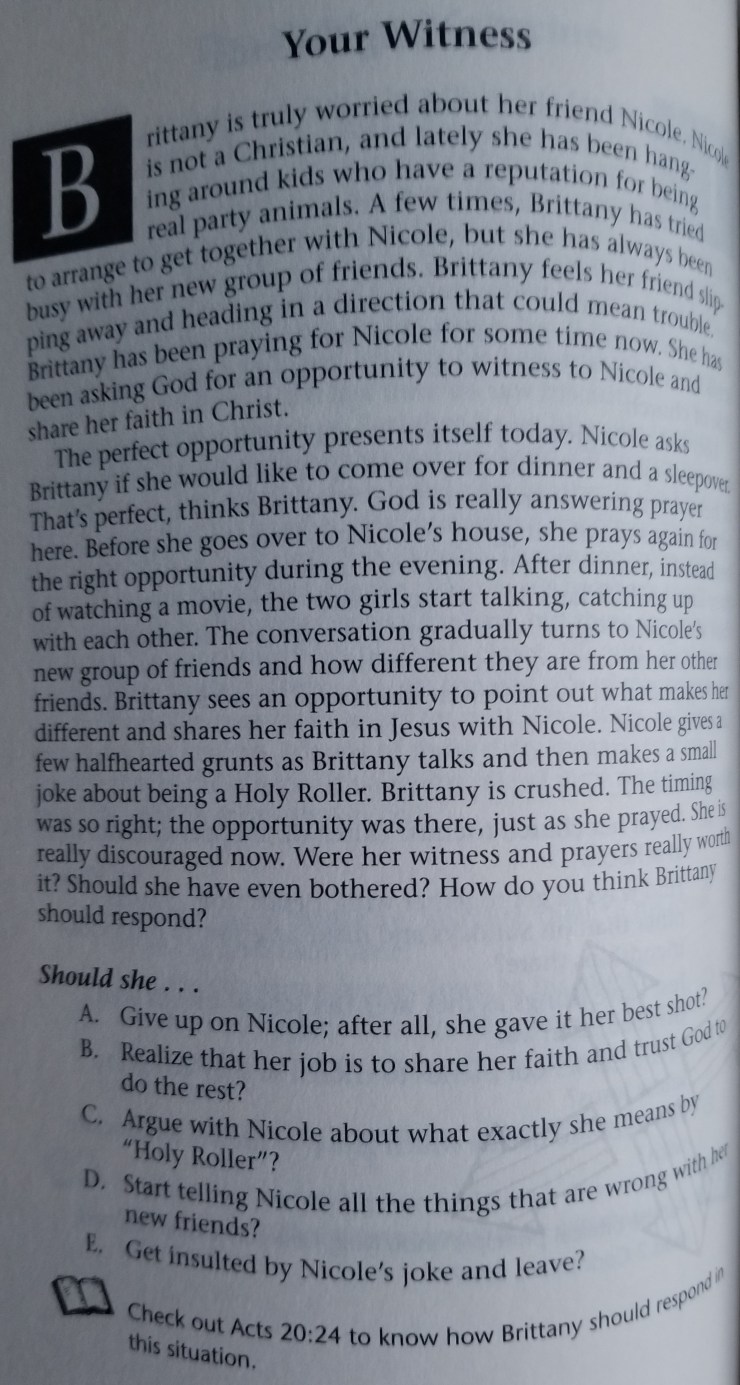 And we talked about the fact that even though we may not immediately see the impact of our witness and our testimony, that we must continue to sow the seed of the good news of Jesus Christ — with our words, and also especially with our lives, so that it clearly demonstrates to others this hope and joy that we have found.
But I do not account my life of any value nor as precious to myself, if only I may finish my course and the ministry that I received from the Lord Jesus, to testify to the gospel of the grace of God.
Acts 20:24 ESV
My wife had just shared this image recently on Facebook, and we mentioned and discussed the truth about sowing seeds and trusting the Lord to do His work in the lives of others in His time: And just as we finished up our lesson, Mia found that Pompom, our pomeranian, had torn up another one of her dog toys — a skunk’s bottom that she had torn open and pulled out its insides. My wife takes these toys repeatedly and sets them aside until she has time to sow them up and give them back to Pompom later to play with. Mia said excitedly, “That’s like our lesson today! Mommy has to sow before Pompom gets to enjoy them!”
 Yes, Christians, we have to sow before they can benefit. Instead of being complacent and “never getting around to it” we must be eagerly awaiting the right opportunity to share our faith, and we must care enough about THEIR eternity enough to live consistently in a peculiar and different, set apart way that is consistently a demonstration of Christ in us sho that there is something to be noticed, to be seen, to be questioned, to be believed when we give such a miraculous testimony of Christ come to live in us and through us.
Heavenly Father, by the power of your Holy Spirit, and to your glory and honor and the righteous testimony of Christ Jesus who is the worthy Lamb of God — help us to be bold enough to bear witness, patient enough to live a faithful testimony, and loving of you and of others enough to know and believe the value in laying down our old lives of sin to live for you and to live for them. Help us to die to self daily and live for you, and sow the seed of the gospel consistently, knowing that the gospel has eternal consequences in the lives of those who receive the seed and it grows to one day bear wonderful, beautiful, nourishing fruit into their lives and the lives of those around them. Help us, Lord. Amen.

Mind Your Own Business and Work Hard

Make it your goal to live a quiet life, minding your own business and working with your hands, just as we instructed you before. Then people who are not believers will respect the way you live, and you will not need to depend on others.
1 Thessalonians 4:11-12 NLT
Life Application Study Bible
There is more to Christian living than simply loving other Christians. We must be responsible in all areas of life. Some of the Thessalonian Christians had adopted a life of idleness, depending on others for handouts. Some Greeks looked down on manual labor. So Paul told the Thessalonians to work hard and live a quiet life. You can’t be effective in sharing your faith with others if they don’t respect you. Whatever you do, do it faithfully and be a positive force in society.
Paul speaks a second time about this issue in this letter to the Thessalonian believers:
Brothers and sisters, we urge you to warn those who are lazy. Encourage those who are timid. Take tender care of those who are weak. Be patient with everyone.
1 Thessalonians 5:14 NLT
And in his follow up letter to the Thessalonians, we see him speaking even more directly, after he starts to end his letter in 2 Thessalonians 3:1-5, but then shares that he “must share this command”:
Now we command you, brothers, in the name of our Lord Jesus Christ, that you keep away from any brother who is walking in idleness and not in accord with the tradition that you received from us.
2 Thessalonians 3:6 ESV

I like the sermon notes from Dr. Ralph F. Wilson on this topic (found here http://www.jesuswalk.com/thessalonians/09_idleness.htm ):
This phrase variously translated “idle” (NIV), “living in idleness” (NRSV), “walketh disorderly” (KJV) — both here and in verse 11 — is a combination of the verb parapateō, “walk, conduct oneself” and the adverb ataktos, which means, “not in the proper order.”[311] The related verb, atakteō, is found in verse 7. Originally, it referred to soldiers marching out of order or quitting the ranks, thus it has the idea of “to be neglectful of duty, to be lawless.”[312]
Instead of doing their fair share to support themselves and help the poor in the Christian community, these idlers are lazy, hanging around other believers, and then expecting to be asked for dinner and given a place to sleep — night after night!
“Command” is a strong verb, parangellō, used here and in verses 10 and 12: “to make an announcement about something that must be done, give orders, command, instruct, direct.” It is a word used by people in authority — worldly rulers, Jesus, the apostles, etc.[313]
Paul isn’t talking about people who can’t earn a living because of sickness, mental instability, age, or infirmity. He isn’t talking about widows who have no support, or orphans whose parents have died. He’s talking about people who could work, but don’t.
Paul’s command to the believers is to “keep away” from these lazy people.
And:
Paul isn’t teaching a so-called “Protestant work ethic” here.[314] Rather he is teaching the concept of taking responsibility for oneself and one’s family, a basic concept that is found throughout the Bible. Paul reiterates this concept to Timothy:
“If anyone does not provide for his relatives, and especially for his immediate family, he has denied the faith and is worse than an unbeliever.” (1 Timothy 5:8)
Paul ran across laziness elsewhere. In the church of Ephesus he gives instructions to former thieves: Get a job, do something productive, so that you may add to the community, not take away from it.
“He who has been stealing must steal no longer, but must work, doing something useful with his own hands, that he may have something to share with those in need.” (Ephesians 4:28)
Hard work is the norm laid out in Genesis:
“By the sweat of your brow you will eat your food….” (Genesis 3:19a)
The book of Proverbs especially is pretty hard on “sluggards.” Here are some examples:
“Go to the ant, you sluggard;
consider its ways and be wise!” (Proverbs 6:6)“Lazy hands make a man poor,
but diligent hands bring wealth.
He who gathers crops in summer is a wise son,
but he who sleeps during harvest is a disgraceful son.” (Proverbs 10:4-5)“The sluggard craves and gets nothing,
but the desires of the diligent are fully satisfied.” (Proverbs 13:4)“One who is slack in his work is brother to one who destroys.” (Proverbs 18:9)
“The sluggard’s craving will be the death of him,
because his hands refuse to work.
All day long he craves for more,
but the righteous give without sparing.” (Proverbs 21:25-26)“A sluggard does not plow in season;
so at harvest time he looks but finds nothing.” (Proverbs 20:4)“I went past the field of the sluggard,
past the vineyard of the man who lacks judgment;
thorns had come up everywhere,
the ground was covered with weeds,
and the stone wall was in ruins.
I applied my heart to what I observed
and learned a lesson from what I saw:
A little sleep, a little slumber, a little folding of the hands to rest —
and poverty will come on you like a bandit
and scarcity like an armed man.” (Proverbs 24:30-34)“The sluggard is wiser in his own eyes
than seven men who answer discreetly.” (Proverbs 26:16)“If a man is lazy, the rafters sag;
if his hands are idle, the house leaks.” (Ecclesiastes 10:18)Women, too, were responsible to do their share.
“[The capable wife] watches over the affairs of her household
and does not eat the bread of idleness.” (Proverbs 31:27)Paul advises Timothy not to put younger women on a list of widows who receive support from the church. Rather they should remarry. It’s obvious by his comments that he’s seen the result of idle women harming the church because they have too much time on their hands.
“As for younger widows, do not put them on such a list…. They get into the habit of being idle[315] and going about from house to house. And not only do they become idlers, but also gossips and busybodies, saying things they ought not to.” (1 Timothy 5:11, 13)
Paul teaches the same lessons to others. To the Ephesian elders, he said:
“You yourselves know that these hands of mine have supplied[316] my own needs and the needs of my companions. In everything I did, I showed you that by this kind of hard work we must help[317] the weak, remembering the words the Lord Jesus himself said: ‘It is more blessed to give than to receive.'” (Acts 20:34-35)
To the Corinthians he says,
“We work hard with our own hands….” (1 Corinthians 4:12a)
For the believers in Crete, Paul instructed Titus:
“Our people must learn to devote themselves to doing what is good, in order that they may provide for daily necessities and not live unproductive lives.” (Titus 3:14)
The Bible is consistent here. We are to work so that we can care for our own needs, and for those who are weak and can’t work.
And for those who would point their judgemental fingers at full time Christian workers, preachers, ministers or missionaries who depend on support to continue in their life’s dedication to the Lord’s work, he makes a distinction between faithfully supporting the ministers of the church versus enabling the idle:
One’s own personal example is powerful. Paul’s lifestyle was abundantly clear to the Thessalonian believers. Let’s look at the elements of verse 8.
- “Toil” (NIV), “labor” (NRSV, KJV), kopos, carries the idea “to engage in activity that is burdensome, work, labor, toil.”[320]
- “Hardship” (NIV), “toil” (NRSV), “travail” (KJV) is mochthos, “labor, exertion, hardship.”[321] Robertson notes that it is an “old word for difficult labor, harder than kopos (toil).”[322]
- “Worked” (NIV, NRSV), “laboring” (KJV) is ergazomai, “to engage in activity that involves effort, work.”[323]
Hard work isn’t to be avoided or to be ashamed of; it is part of the life of a disciple of Jesus!
Notice that in 3:9, Paul does not say that all apostles or Christian workers should support themselves! Let’s not over interpret this.
“We did this, not because we do not have the right[324]to such help, but in order to make ourselves a model for you to follow.” (3:9)
His purpose is to give the believers an example or model[325]of hard work, not to set a precedent for all Christian workers. To the Corinthians he outlines the case for supporting Christian workers, and reserves his right to be supported for his work in the gospel, while choosing not to exercise it.
“Don’t we have the right to food and drink? Don’t we have the right to take a believing wife along with us, as do the other apostles and the Lord’s brothers and Cephas? … If others have this right of support from you, shouldn’t we have it all the more? But we did not use this right. On the contrary, we put up with anything rather than hinder the gospel of Christ.” (1 Corinthians 9:4-5, 12)
So we don’t use this “command to work hard” as some weapon to hold as justification for our holding onto “our precious money” by refusing to support the church and those in full time ministerial positions — that is sin, and must be repented, you who are greedy and judgemental and hard hearted.
No, this is meant for discipline and clear guidance when dealing with lazy, and people — who seek to use others to enable their slothful and unproductive lifestyle choices:
“For even when we were with you, we gave you this rule: ‘If a man will not work,[326] he shall not eat.'” (3:10)
Observe four things here.
- Persistent sin. The problem of laziness had existed from the church’s foundation — and Paul had taught about it then.
- Command. Paul’s instruction about work at the founding of the church wasn’t just a suggestion, but a command.[327]
- Willful sin. The issue is obedience to the Biblical injunction. The lazy believers know what the Bible says, but resist it. The will[328] is at stake here. Paul isn’t talking about those who can’t find work, those who are homeless against their will, or who are physically or mentally unable to work, but those who have no intention of working to support themselves.
- Consequences of actions. Paul commands the believers to step back from continually “bailing out” the lazy people, and let the consequences of their actions teach them what they won’t learn otherwise. Don’t feed them — and don’t feel guilt about it yourself
Why is this so important?
“11 We hear that some among you are idle. They are not busy; they are busybodies.
12 Such people we command and urge in the Lord Jesus Christ to settle down and earn the bread they eat. 13 And as for you, brothers, never tire of doing what is right.” (3:11-13)The laziness is causing two problems in the body.
1. Lazy people become busybodies and meddlers who hurt relationships in the body. Verse 11b includes a play on words that the NIV captures to some extent:
“They are not busy (ergazomai); they are busybodies (periergazomai).”
“Busybodies” is periergazomai, “to be intrusively busy, be a busybody, meddler.”[329] Thayer defines it, “to bustle about uselessly, to busy oneself about trifling, needless, useless matters.”[330]
Later in his ministry, Paul sees the same problem of busybodies in Ephesus among young widows with time on their hands.[331]
The situation at Thessalonica is serious and must be fixed. That’s why Paul can’t just hint at a solution. So in verse 12, Paul both uses two strong verbs, “we command (parangellō) and urge (“exhort,” KJV, NRSV, parakaleō) in the Lord Jesus Christ” (cf. 3:1, 10). The command is:
“To settle down and earn the bread they eat.” (3:12b)
The phrases “settle down and earn” (NIV), “work quietly” (NRSV), “with quietness work” (KJV) translate three words: the verb ergazomai, “work” (which we’ve seen several times in this passage), the preposition meta, “with,” and the noun hēsychia, “state of quietness without disturbance, quietness, rest,” that is, living in a way that does not cause disturbance.[332] I think that the NIV’s “settle down and earn” catches the idea well. These lazy people are stirring up others with their gossipy, busybody behavior. People resent them. The church is disturbed about it. So the lazy people are commanded to begin to work and stop stirring things up. As they begin to work, the dissension in the body will quiet down.
2. Lazy people can “burn out” or discourage church members from being generous and outgoing to the truly needy. The great majority of the believers at Thessalonica, no doubt, earn their own living, but have been putting up with the Christian freeloaders for far too long. They’re tired of it. They’ve worn themselves out trying to do the “loving” thing. Paul wants to encourage them keep on doing good works — just not to enable the lazy believers among them.
“And as for you, brothers, never tire of doing what is right.” (3:13)
“Never tire” (NIV), “do not be weary” (NRSV, cf. KJV) is ekkakeō, “lose heart,”[333] literally, “to be utterly spiritless, to be wearied out, exhausted.”[334] Elsewhere, the New Testament exhorts people not to let discouragement immobilize them:
“Therefore, since through God’s mercy we have this ministry, we do not lose heart.” (2 Corinthians 4:1)
“I ask you, therefore, not to be discouraged because of my sufferings for you, which are your glory.” (Ephesians 3:13)
“Therefore we do not lose heart. Though outwardly we are wasting away, yet inwardly we are being renewed day by day.” (2 Corinthians 4:16)
“Consider him who endured such opposition from sinful men, so that you will not grow weary and lose heart.” (Hebrews 12:3)
Having worked with those in need trying to help get them back on their feet after tragedy, addiction, unforeseen circumstances, and consequences of poor decisions — I can tell you that laziness and idleness in a person that you are trying to help is a immediate red flag. When we have ignored the signs, and continued trying to help someone who is not eager and willing to work hard to provide for themselves and their family — when we have shifted from equipping to enabling — it has always cost them and cost us as well. To avoid this trap, we must be conscious and intentional with our boundaries and limits (which can receive accusations of being cold and cruel), but is necessary and best.
“Our people must learn to devote themselves to doing what is good, in order that they may provide for daily necessities and not live unproductive lives.” (Titus 3:14)
Lord, help us and guide us in such things, to your glory and honor, Amen!
Who might we be overlooking
This morning’s verse is:
But the Lord said to Samuel, “Don’t judge by his appearance or height, for I have rejected him. The Lord doesn’t see things the way you see them. People judge by outward appearance, but the Lord looks at the heart.”
1 Samuel 16:7 NLT
I love this historical narrative from the appointment of a son of Jesse to be King of Israel.When studying this part of Israel’s past, we find that the people had chosen Saul as their King because of their own preconceived notions about things like appearance and height — and that God allowed them to make a poor decision instead of consulting Him and trusting in God’s appointment alone — but that Saul proved to be a bad King, and turned away from the Lord, and was rejected by the Lord. And the Lord told the prophet Samuel that a new King would be appointed, and that it would be a son of Jesse, and told Samuel to go to Jesse and that God would reveal which son it would be.
Now the Lord said to Samuel, “You have mourned long enough for Saul. I have rejected him as king of Israel, so fill your flask with olive oil and go to Bethlehem. Find a man named Jesse who lives there, for I have selected one of his sons to be my king.”
1 Samuel 16:1 NLT
Samuel came into the town and was performing a purification ceremony and sacrifice so that it would not yet be clearly evident to the people why he was there and what he was doing. And Jesse and his sons were invited. As the sons of Jesse arrive, Samuel looks at them and we see him make the same mistake that the people had made in choosing Saul, and this is where our verse this morning comes from:
When they arrived, Samuel took one look at Eliab and thought, “Surely this is the Lord ’s anointed!” But the Lord said to Samuel, “Don’t judge by his appearance or height, for I have rejected him. The Lord doesn’t see things the way you see them. People judge by outward appearance, but the Lord looks at the heart.”
1 Samuel 16:6-7 NLT
Samuel, because he was an imperfect man, fell into the same trap — he judged with his eyes. If Samuel had made the decision with his own judgement and conscience, showing preference to his own poor choice for a king, he would have also overlooked and the people would have missed out on the opportunity of God’s chosen King. And even Jesse, the father, had overlooked David and left him tending the sheep in the field.
In the same way all seven of Jesse’s sons were presented to Samuel. But Samuel said to Jesse, “The Lord has not chosen any of these.” Then Samuel asked, “Are these all the sons you have?” “There is still the youngest,” Jesse replied. “But he’s out in the fields watching the sheep and goats.” “Send for him at once,” Samuel said. “We will not sit down to eat until he arrives.” So Jesse sent for him. He was dark and handsome, with beautiful eyes. And the Lord said, “This is the one; anoint him.” So as David stood there among his brothers, Samuel took the flask of olive oil he had brought and anointed David with the oil. And the Spirit of the Lord came powerfully upon David from that day on. Then Samuel returned to Ramah.
1 Samuel 16:10-13 NLT
Such a beautiful reminder that God knows better than us the true value and right appointments of His people. When people measure and compare by outwardly measurable metrics alone and do not consult with the Lord — the resulting appointments are out of order, skewed, and aren’t best.This should have us asking ourselves — who am I showing potential treatment towards in my life — and as a result, who might I be overlooking?And what idols and distractions and temptations have my attention that could be laid aside so that I could have Christ as King, the perfect and best?Have we overlooked and rejected Christ because of the desires of our flesh, the desires of our eyes, our ot of our own pride — we should know that this is the root of all sin, and we should repent, and seek God’s counsel instead.
It doesn’t matter what I say or what they say, but only matters what YOU SAY oh, Lord.
Lord, help us to consult with you constantly, to pray without ceasing because we are walking with you. Guide or every decision not by or flawed and biased measurements and reasoning, but by your perfect revelation. Amen.
Our related Sticky Situations devotional this morning:

Today’s Forecast: Victorious Living
My morning wake up verse was 2 Peter 3:14 that is an element of how we should be living in “these last days”:
But the day of the Lord will come as unexpectedly as a thief. Then the heavens will pass away with a terrible noise, and the very elements themselves will disappear in fire, and the earth and everything on it will be found to deserve judgment. Since everything around us is going to be destroyed like this, what holy and godly lives you should live, looking forward to the day of God and hurrying it along. On that day, he will set the heavens on fire, and the elements will melt away in the flames. But we are looking forward to the new heavens and new earth he has promised, a world filled with God’s righteousness. And so, dear friends, while you are waiting for these things to happen, make every effort to be found living peaceful lives that are pure and blameless in his sight.
2 Peter 3:10-14 NLT
The Life Application Study Bible comments on this verse:
We should not become lazy and complacent because Christ has not yet returned. Instead, we should live in eager expectation of his coming. What would you like to be doing when Christ returns? That is how you should be living each day.
And our family devotion from Sticky Situations this morning was about not caving to peer pressure that might tempt us into compromising a life that is
pure and blameless in his sight.
And doing this by making:
every effort to be found living peaceful lives
Here is the devotional:

And here is the answer key:

It references two passages in Deuteronomy for reference:
And when you look up into the sky and see the sun, moon, and stars—all the forces of heaven—don’t be seduced into worshiping them. The Lord your God gave them to all the peoples of the earth.
Deuteronomy 4:19 NLT“When you enter the land the Lord your God is giving you, be very careful not to imitate the detestable customs of the nations living there. For example, never sacrifice your son or daughter as a burnt offering. And do not let your people practice fortune-telling, or use sorcery, or interpret omens, or engage in witchcraft, or cast spells, or function as mediums or psychics, or call forth the spirits of the dead. Anyone who does these things is detestable to the Lord . It is because the other nations have done these detestable things that the Lord your God will drive them out ahead of you. But you must be blameless before the Lord your God. The nations you are about to displace consult sorcerers and fortune-tellers, but the Lord your God forbids you to do such things.”
Deuteronomy 18:9-14 NLT
And we can find many pages in the New Testament as well that teach us about Holy Living, about Christian Living:
If you are kind only to your friends, how are you different from anyone else? Even pagans do that. But you are to be perfect, even as your Father in heaven is perfect.
Matthew 5:47-48 NLT
And a sermon that I found from Spurgeon this morning on thos very verses proves powerful on this subject: https://www.blueletterbible.org/Comm/spurgeon_charles/sermons/1029.cfm
Spurgeon speaks plainly and clearly on this topic:
We are justified by faith, and not by the works of the law. The merit by which a soul enters heaven is not its own; it is the merit of our Lord and Savior Jesus Christ. I am quite sure that you will all hold me guiltless of ever having spoken about this great doctrine in any other than unmistakable language; if I have erred, it is not in that direction. At the same time, it is a dangerous state of things if doctrine is made to drive out precept, and faith is held up as making holiness a superfluity. Sanctification must not be forgotten or overlaid by justification. We must teach plainly that the faith which saves the soul is not a dead faith, but a faith which operates with purifying effect upon our entire nature, and produces in us fruits of righteousness to the praise and glory of God. It is not by personal holiness that a man shall enter heaven, but yet without holiness shall no man see the Lord. It is not by good works that we are justified, but if a man shall continue to live an ungodly life, his faith will not justify him; for it is not the faith of God’s elect; since that faith is wrought by the Holy Spirit, and conforms men to the image of Christ...
Precepts are not given to us as a way to obtain life, but as the way in which to exhibit life. The commands of Christ are not upon the legal tenor of “this do and live,” but upon the gospel system of “live and do this.” We are not to be attentive to the precepts in order to be saved, but because we are saved. Our master motive is to be gratitude to him who has saved us with a great salvation. I am sure that every renewed heart here will feel no opposition to the most holy precepts of our Lord...
The regenerate never rebel against any precept, saying, “This, is too pure;” on the contrary, our new-born nature is enamoured of its holiness, and we cry, “Thy word is very pure, therefore thy servant loveth it. O that my ways were directed to keep thy statutes.”
Even though we find that when we would do good evil is present with us, yet our inmost soul longs after holiness, and pines to be delivered from every evil way. At any rate, Dear friends, if it be not so with you, you may well question whether you are indeed the children of God. My desire, this morning, is to insist upon the precepts which tend to holiness, and I pray the Holy Spirit to excite desires after a high degree of purity in all believing, hearts.
Too many persons judge themselves by others; and if upon the whole they discover that they are no worse than the mass of mankind, they give themselves a mark of special commendation…
they go to their place of worship as if they were saints, and bear the name of Christian as if it belonged to them; they share in Christian privileges, and sit with God’s people, as if they were truly of the family, their marks and evidences being just these, that they do about as much upon the whole as other people, and if they are not first they are not altogether last. The nests of such people ought to be grievously disturbed when they read the chapter before us, for there the Master insists upon a higher standard than the world’s highest, and tells us that except our righteousness exceeds that of the scribes and Pharisees, we cannot enter into the kingdom of heaven...what is the indwelling Spirit within us? Is he not Omnipotence itself? The Holy Ghost who has come upon us is no influence which might be limited in its efficacy; but he is a divine person, who dwelleth with us and shall be in us. Who shall set any limit to the power of that man in whom the Holy Ghost himself dwells? All believers, are must never dare to say, “That habit we cannot give up.” We can and must overturn all the idols in our hearts. We may never say, “That height of devotion I can never reach.”…
We are never to sit down and say, “I must be a sinner up to such-and-such a point; I cannot get beyond that attainment.” What saith the Scripture? “Be ye perfect even as your Father which is in heaven is perfect;” after this perfection we are to strain, and towards this mark of our high calling we are to press. God who dwells in us is working in us daily to will and to do according to his own good pleasure, so that we can do what the dead sinner cannot do; we can do what sinners, without the Spirit, cannot do; and, if we can, we must. Surely, it is required of a man according to what he hath, and where much is given much will be required. Let us take care that we quench not the Spirit, that by our unbelief we restrain not his divine energies; but let us strive, God striving in us, after the highest conceivable standard of holiness and of separation from the world. O Spirit of God, do thou help us that we may be sanctified by thy grace, spirit, soul, and body.
Oh, Holy Spirit of God, help us so that we will be sanctified by your grace, made holy as you are holy, in our Spirit, Soul, Body, Mind, Words, Actions and innermost Being. Amen.
Keep Praying
My morning “wake up” devotional verse this morning was:
But you must not forget this one thing, dear friends: A day is like a thousand years to the Lord, and a thousand years is like a day. The Lord isn’t really being slow about his promise, as some people think. No, he is being patient for your sake. He does not want anyone to be destroyed, but wants everyone to repent.
2 Peter 3:8-9 NLT
And the Life Application Study Bible had these notes to consider on this verse:
God may have seemed slow to these believers as they faced persecution every day and longed to be delivered. But God is not slow; he just is not on our timetable. Jesus is waiting so that more sinners will repent and turn to him. We must not sit and wait for Christ to return, but we should live with the realization that time is short and that we have important work to do. Be ready to meet Christ any time, even today; yet plan your course of service as though he may not return for many years.
Then, Mia came down to join us for our morning family devotional, and the Sticky Situations devotional for Kids and Families had this to share:
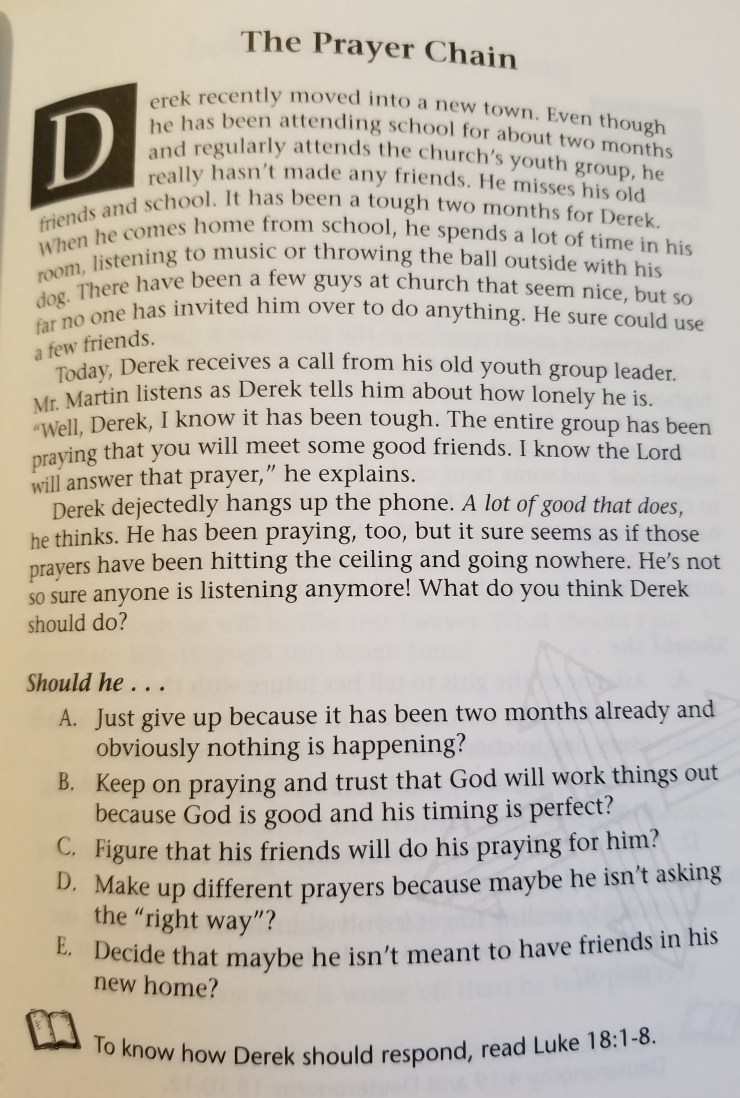
And had us reading and considering this page from Luke:
One day Jesus told his disciples a story to show that they should always pray and never give up. “There was a judge in a certain city,” he said, “who neither feared God nor cared about people. A widow of that city came to him repeatedly, saying, ‘Give me justice in this dispute with my enemy.’ The judge ignored her for a while, but finally he said to himself, ‘I don’t fear God or care about people, but this woman is driving me crazy. I’m going to see that she gets justice, because she is wearing me out with her constant requests!’” Then the Lord said, “Learn a lesson from this unjust judge. Even he rendered a just decision in the end. So don’t you think God will surely give justice to his chosen people who cry out to him day and night? Will he keep putting them off? I tell you, he will grant justice to them quickly! But when the Son of Man returns, how many will he find on the earth who have faith?”
Luke 18:1-8 NLT
I immediately saw patient endurance and faith as the 10,000ft view (the revelation of truth) that I need to be mindful of, and consistency in my own prayer life as the primary target (the area of application) where I can repent and grow.
I can at times find myself studying and growing in knowledge and familiarity with the scriptures themselves, but also finding the fervency of my prayer life waning. When I’ve prayed time and time again around and over an issue or circumstance looking for a solution, I sometimes forget that praying and praising through the trial is the picture of faith.
I also sometimes get hung up on the issues that are closest to me, that are affecting me daily, that are uncomfortable for me — and I forget that these are my “opportunities to suffer gracefully to the glory of God” — and that even these aren’t persecution, but are usually just consequences of my own poorly chosen decisions.
I am realizing that many times I have been missing opportunities to pray for the very real needs of others (that are seemingly far more challenging and desperate than my want). I not only overlook my own blessed life, but pick apart what isn’t “perfect” and “comfortable” by my own standards of want, while others are facing very real need. When there are those around me truly suffering every day, why do I find myself forgetting them too often in my prayers and instead grumbling to God about every little thing that isn’t comfortable or easy for me in the moment?
It’s humbling to see how quickly I can fall into a selfish, grumbling mindset.
It’s humbling to see how easily I lose faith in trusting that God has a plan, a purpose, and perfect timing.
So now, instead of continuing to “write and preach” this morning — I’m confessing that I’m just a needy student and disciple of the Word like you, friend. I don’t have it all nailed down. I’m not getting it all right. It seems to me like I stumble more than I walk. I look at this perfect example of Christ in the written Word, and I find myself not just a step or two short of ther glory of God, but far on the other end of the spectrum. If measuring the evidence of our own godliness along a chart the length of a marathon, I wonder if we have even progressed the width of a single hair? When I remember that there is no good in us apart from Christ, I am reminded of our utter need.
It is no coincidence that the next page in Luke is also about prayer:
Then Jesus told this story to some who had great confidence in their own righteousness and scorned everyone else: “Two men went to the Temple to pray. One was a Pharisee, and the other was a despised tax collector. The Pharisee stood by himself and prayed this prayer : ‘I thank you, God, that I am not like other people—cheaters, sinners, adulterers. I’m certainly not like that tax collector! I fast twice a week, and I give you a tenth of my income.’ “But the tax collector stood at a distance and dared not even lift his eyes to heaven as he prayed. Instead, he beat his chest in sorrow, saying, ‘O God, be merciful to me, for I am a sinner.’ I tell you, this sinner, not the Pharisee, returned home justified before God. For those who exalt themselves will be humbled, and those who humble themselves will be exalted.”
Luke 18:9-14 NLT
I wonder how much more our prayers about ourselves ought to be humble prayers seeking forgiveness, mercy, and the granting to us of repentance — while pleas for blessing and favor and healing might be best poured out first and foremost onto the need all around us? I wonder how often I have this backwards in a self serving manner?
What is causing the quarrels and fights among you? Don’t they come from the evil desires at war within you? You want what you don’t have, so you scheme and kill to get it. You are jealous of what others have, but you can’t get it, so you fight and wage war to take it away from them. Yet you don’t have what you want because you don’t ask God for it. And even when you ask, you don’t get it because your motives are all wrong—you want only what will give you pleasure. You adulterers! Don’t you realize that friendship with the world makes you an enemy of God? I say it again: If you want to be a friend of the world, you make yourself an enemy of God. Do you think the Scriptures have no meaning? They say that God is passionate that the spirit he has placed within us should be faithful to him. And he gives grace generously. As the Scriptures say, “God opposes the proud but gives grace to the humble.” So humble yourselves before God. Resist the devil, and he will flee from you. Come close to God, and God will come close to you. Wash your hands, you sinners; purify your hearts, for your loyalty is divided between God and the world. Let there be tears for what you have done. Let there be sorrow and deep grief. Let there be sadness instead of laughter, and gloom instead of joy. Humble yourselves before the Lord, and he will lift you up in honor.
James 4:1-10 NLT
Lord, help us pray rightly and consistently and humbly close with you. Amen.
Don’t Be Surprised that You are “Barely Saved” and “Suffering”
Dear friends, don’t be surprised at the fiery trials you are going through, as if something strange were happening to you. Instead, be very glad—for these trials make you partners with Christ in his suffering, so that you will have the wonderful joy of seeing his glory when it is revealed to all the world. If you are insulted because you bear the name of Christ, you will be blessed, for the glorious Spirit of God rests upon you. If you suffer, however, it must not be for murder, stealing, making trouble, or prying into other people’s affairs. But it is no shame to suffer for being a Christian. Praise God for the privilege of being called by his name! For the time has come for judgment, and it must begin with God’s household. And if judgment begins with us, what terrible fate awaits those who have never obeyed God’s Good News? And also, “If the righteous are barely saved, what will happen to godless sinners?” So if you are suffering in a manner that pleases God, keep on doing what is right, and trust your lives to the God who created you, for he will never fail you.
1 Peter 4:12-19 NLT
“It Is Well” with Kelcie
https://www.smule.com/p/471491380_2949908331
Trials.
For someone with no faith, they are just meaningless hardships with no plan or purpose. When there is no faith, things like unexpected sickness, unfair circumstances, etc are all just random, chaotic events beyond their control that a person must A) accept and deal with, hopeless that there circumstances will change for the better or B) run from challenges to find the path of least resistance.
A coworker has been dealing with weird health issues recently, and the doctors so far have been no help for him. No answers. No diagnoses. No advice. No help.
And this isn’t some nagging condition or symptoms — at times, my coworker is overwhelmed by physical symptoms that had him fearful that he might die right at that moment. He’s a young fellow, and he has been fighting to keep his frustration and fear under wraps as he contemplates very real and close (not like some theoretical philosopher) his own life and morality.
He is a professed atheist, and even though he had been curious enough at times to ask me about my faith, he already has such a wall of disgust built up towards “religion” and the atrocities committed throughout history by “religious people”, etc. that he cannot yet grasp hold of the concept of a relationship with a living God that isn’t just foolishness, tradition, ceremony, control and exploitation.
But he is going through a trial, and it is clearly visible in his voice, on his face, in his eyes, in his attitude and in every part of his life right now. And this IS the norm. There is no shame in such things. It is expected when people have no hope beyond themselves.
But if we have faith, shouldn’t our source of hope in Christ offer a different response and attitude and reaction to suffering than the norm?
I wonder how much more it would draw even the most hardened of atheists to at least question and consider the things of God if all the Christians weren’t so fearful and grumbling and critical of their trials, but met them gladly and praised God for the opportunity to suffer and testify to His glory even in the middle of great suffering and trial?
I wonder how much more effective then or reasoning with them and sharing this Good News would prove when the lost actually saw us living, loving, suffering, persisting and encouraging with a fire that burns brightly and consistently regardless of our circumstances.
Such things are beyond a mere man’s power, and we would fall short every time if we’r wye alone and operating solely under our own power and abilities. We might forget or source of hope and cower in the boat instead of stepping out onto the water — and even once we have stepped out, we might falter again, thinking that it is up to us to stay lifted up upon the waters instead of simply trusting God’s call to walk.
But we who know and love the Lord, and who are called according to His purposes — we do not walk alone. We do not suffer alone. And we do not endure fiery trials without purpose or plan, but for the molding and building of our character and nature and very being to demonstrate Christ to a lost and dying world.
So don’t seek out suffering or trial or problems in order to “prove yourself a mighty man or woman of God” and don’t run from trials as if God has abandoned you. Like the young errand boy, who was looked down on by so many mighty warriors, who was overlooked by his own family, who had no armor of his own, who had no personal experience in battling giants, we can say when faced with the total set before us, “Today the Lord will conquer you” when we face an enemy so great or challenging before us that we know that any amount of our own skill throwing rocks would be insufficient without God’s hand of protection guiding us to the battlefield and to the victory.
David wasn’t a great rock slinger. He was just a man who God walked with, a man who knew and lived God. He was a very flawed and imperfect man with nothing good in him apart from Christ, but he was not someone content to stay “apart from Christ”. Lord, let us not see David as a powerful warrior or victor — so that we do not miss what is actually at play — and so that we don’t think highly or lowly of others or ourselves and miss out on your glory alone. Only you are worthy of honor and praise!
Lord, if you will, come and breathe into us this peculiar light of something so different than the world — that we will be content and praise you whether you give or take away — and that we will not stumble or hinder others from seeing your light because of our many shortcomings and lack of faith. Lord, heal us off or unbelief, change or hearts and minds to be more like you. Walk close with us, even along the still waters, even in the valleys, especially upon the mountain tops, and not just in the midst of the fiery trial, but behind us ahead of us, and all around us. Like Elisha and his servant, faced with an army of enemies around them, let us see that there are more Heavenly hosts and warring angels around and protecting your children than the greatest of challenging circumstances could present in this world. Remind us humbly that even though we are barely saved, that we are barely saved nonetheless, and that should be the source of such a grateful life of hope, of faith, of love, of praise, and of worship. Amen.
Gifted and Talented

We are given gifts — who will those gifts serve most today?
God has given each of you a gift from his great variety of spiritual gifts. Use them well to serve one another. Do you have the gift of speaking? Then speak as though God himself were speaking through you. Do you have the gift of helping others? Do it with all the strength and energy that God supplies. Then everything you do will bring glory to God through Jesus Christ. All glory and power to him forever and ever! Amen.
1 Peter 4:10-11 NLT
Life Application Study Bible
Some people, well aware of their abilities, believe that they have the right to use their abilities as they please. Others feel that they have no special talents at all. Peter addresses both groups in these verses. Everyone has some gifts; find yours and use them. All our abilities should be used in serving others; none are for our own exclusive enjoyment. Peter mentions speaking and serving.
Matthew Henry Commentary on 1 Peter 4
The work of a Christian is twofold-doing the will of God and suffering his pleasure. This chapter directs us in both. The duties we are here exhorted to employ ourselves in are the mortification of sin, living to God, sobriety, prayer, charity, hospitality, and the best improvement of our talents, which the apostle presses upon Christians from the consideration of the time they have lost in their sins, and the approaching end of all things (v. 1-11). The directions for sufferings are that we should not be surprised at them, but rejoice in them, only take care not to suffer as evil-doers. He intimates that their trials were near at hand, that their souls were in danger as well as their bodies, and that the best way to preserve their souls is to commit them to God in well-doing (v. 12-19).
- The rule is that whatever gift, ordinary or extraordinary, whatever power, ability, or capacity of doing good is given to us, we should minister, or do service, with the same one to another, accounting ourselves not masters, but only stewards of the manifold grace, or the various gifts, of God. Learn,
- [1.] Whatever ability we have of doing good we must own it to be the gift of God and ascribe it to his grace.
- [2.] Whatever gifts we have received, we ought to look upon them as received for the use one of another. We must not assume them to ourselves, nor hide them in a napkin, but do service with them one to another in the best manner we are able.
- [3.] In receiving and using the manifold gifts of God we must look upon ourselves as stewards only, and act accordingly. The talents we are entrusted with are our Lord’s goods, and must be employed as he directs. And it is required in a steward that he be found faithful.
- (2.) The apostle exemplifies his direction about gifts in two particulars-speaking and ministering, concerning which he gives these rules:-
- [1.] If any man, whether a minister in public or a Christian in private conference, speak or teach, he must do it as the oracles of God, which direct us as to the matter of our speech. What Christians in private, or ministers in public, teach and speak must be the pure word and oracles of God. As to the manner of speaking, it must be with the seriousness, reverence, and solemnity, that become those holy and divine oracles.
- [2.] If any man minister, either as a deacon, distributing the alms of the church and taking care of the poor, or as a private person, by charitable gifts and contributions, let him do it as of the ability which God giveth. He who has received plenty and ability from God ought to minister plentifully, and according to his ability. These rules ought to be followed and practised for this end, that God in all things, in all your gifts, ministrations, and services, may be glorified, that others may see your good works, and glorify your Father who is in heaven (Mt. 5:16), through Jesus Christ, who has procured and given these gifts to men (Eph. 4:8), and through whom alone we and our services are accepted of God (Heb. 13:15), to whom, Jesus Christ, be praise and dominion for ever and ever. Amen. Learn,
- First, It is the duty of Christians in private, as well as ministers in public, to speak to one another of the things of God, Mal. 3:16; Eph. 4:29; Ps. 145:10-12.
- Secondly, It highly concerns all preachers of the gospel to keep close to the word of God, and to treat that word as becomes the oracles of God.
- Thirdly, Christians must not only do the duty of their place, but they must do it with vigour, and according to the best of their abilities. The nature of a Christian’s work, which is high work and hard work, the goodness and kindness of the Master, and the excellency of the reward, all require that our endeavours should be serious and vigorous, and that whatever we are called to do for the honour of God and the good of others we should do it with all our might.
- Fourthly, In all the duties and services of life we should aim at the glory of God as our chief end; all other views must be subservient to this, which would sanctify our common actions and affairs, 1 Co. 10:31.
- Fifthly, God is not glorified by any thing we do if we do not offer it to him through the mediation and merits of Jesus Christ. God in all things must be glorified through Jesus Christ,who is the only way to the Father.
- Sixthly, The apostle’s adoration of Jesus Christ, and ascribing unlimited and everlasting praise and dominion to him, prove that Jesus Christ is the most high God, over all blessed for evermore. Amen.
 Harold J. Ballinger