Liars

In a discussion about God hating liars (Proverbs 6:17, Proverbs 6:19, Proverbs 12:22), the following question came up:

My discussion went along these lines:

“Do you know what a parable is?”

“If one man generates a tale from imaginary characters in order to demonstrate and teach a valuable truth, while another man uses truthful facts to manipulate another to unknowingly participate in a lie, who is the wicked man? Is this not clear?”

“A liar could never speak a fact that is untrue, yet still be a liar through and through because he is deceitful in his dealings, while meticulous in his facts.”

Unfortunately, in this instance, the man wasn’t asking so that we could speak and reason together, but he just wanted to mock God and mock my beliefs in the midst of our discussion. And he saw my questions as insulting and we couldn’t communicate with each other at all. I didn’t even know we were “arguing” initially, I just thought we were talking and asking questions to consider together. Thankfully, a friend revealed to me that it was arguing, so I apologized and departed. No sense debating over words with someone looking for a fight — you aren’t going to change their mind when they aren’t even listening but agree just waiting for their turn to speak.

Let’s not miss seeing the forest for the trees, and let’s not mince words so finely for the sake of finding someone to argue with over things that might be simple enough for a young child to understand.

I really enjoyed looking at this parable from Jesus immediately following this discussion. A parable, that while revealing a truth about “unclean foods”, and also mentioning “deceit” defiling a man, speaks back to instructions given to Israel in Leviticus about this very topic.

Then Jesus called to the crowd to come and hear. “All of you listen,” he said, “and try to understand. It’s not what goes into your body that defiles you; you are defiled by what comes from your heart. ” Then Jesus went into a house to get away from the crowd, and his disciples asked him what he meant by the parable he had just used. “Don’t you understand either?” he asked. “Can’t you see that the food you put into your body cannot defile you? Food doesn’t go into your heart, but only passes through the stomach and then goes into the sewer.” (By saying this, he declared that every kind of food is acceptable in God’s eyes.) And then he added, “It is what comes from inside that defiles you. For from within, out of a person’s heart, come evil thoughts, sexual immorality, theft, murder, adultery, greed, wickedness, deceit, lustful desires, envy, slander, pride, and foolishness. All these vile things come from within; they are what defile you.”
Mark 7:14‭-‬15‭, ‬17‭-‬23 NLT

And this is what was given in Leviticus:

“Give the following instructions to the people of Israel. “Of all the land animals, these are the ones you may use for food. You may eat any animal that has completely split hooves and chews the cud. You may not, however, eat the following animals that have split hooves or that chew the cud, but not both. The camel chews the cud but does not have split hooves, so it is ceremonially unclean for you. The hyrax chews the cud but does not have split hooves, so it is unclean. The hare chews the cud but does not have split hooves, so it is unclean. The pig has evenly split hooves but does not chew the cud, so it is unclean. You may not eat the meat of these animals or even touch their carcasses. They are ceremonially unclean for you. “Of all the marine animals, these are ones you may use for food. You may eat anything from the water if it has both fins and scales, whether taken from salt water or from streams. But you must never eat animals from the sea or from rivers that do not have both fins and scales. They are detestable to you. This applies both to little creatures that live in shallow water and to all creatures that live in deep water. They will always be detestable to you. You must never eat their meat or even touch their dead bodies. Any marine animal that does not have both fins and scales is detestable to you. “These are the birds that are detestable to you. You must never eat them: the griffon vulture, the bearded vulture, the black vulture, the kite, falcons of all kinds, ravens of all kinds, the eagle owl, the short-eared owl, the seagull, hawks of all kinds, the little owl, the cormorant, the great owl, the barn owl, the desert owl, the Egyptian vulture, the stork, herons of all kinds, the hoopoe, and the bat. “You must not eat winged insects that walk along the ground; they are detestable to you. You may, however, eat winged insects that walk along the ground and have jointed legs so they can jump. The insects you are permitted to eat include all kinds of locusts, bald locusts, crickets, and grasshoppers. All other winged insects that walk along the ground are detestable to you.
Leviticus 11:2‭-‬23 NLT

For someone only seeking to mince words, they might abandon these two passages as irreconcilable.

For someone insistent upon measuring and comparing and debating such things, they will find much of what Jesus teaches to be a stumbling block.

But can you step back from this and see the forest, not just the individual trees — even more importantly, can you see our utter and complete need for God?

Can you shift your perspective from being about what “I” or “they” are doing to be about what He has done? This is the ONLY way you will find yourself at His feet, clearly understanding such things. He is the ONE TRUTH, ONE WAY, ONE LIFE. Amen.

Crave

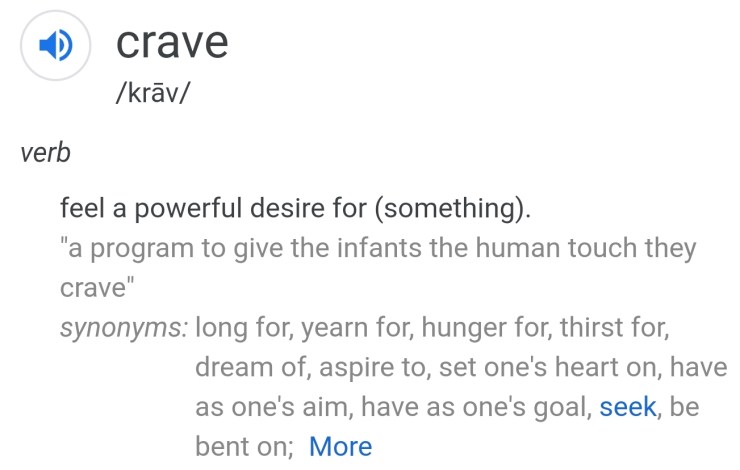
What does it mean to “crave” something?

When we are talking about the topic of likes, wants, needs, and desires — craving is at the extreme end of the spectrum.

When speaking of “craving” something and I look over my own life — I can see times when I “craved” a lot of things that weren’t necessarily good or healthy for me, but that I was drawn to them so powerfully that I might accept unnecessary risks in order to enjoy those things that I was craving. Cravings for things like sex, food, partying — even professional and social recognition — have at times had me chasing cheap, short term comforts and satisfactions at the risk of more costly long term consequences.

I don’t say this to self denigrate or deprecate — but so that we might consider and agree to the “intensity” that is understood in the word “crave”. And I believe that even a small child watching Sesame Street can appreciate this shared experience of what it means to “crave” something, as they watch Cookie Monster saying, “Me want cookie! Me eat cookie!” and lose control of himself attacking the cookies with a voracious “Nom, nom, nom.”

Now you might believe that from what I’ve written so far, that I’m going to tell you about the “dangers of excess” and that “craving” is bad — as if the key to self improvement is to learn to cage your inner cookie monster and become a good (miserable on the inside, but smiling on the outside) vegan instead. But no, there is a lot of impetus and power and motion that “craving” can bring to our lives. We aren’t just looking for a blandly extended lifeline in this discussion — or encouraging a life built around “no, no, no”, “don’t do that”, “don’t eat that”, etc.

What if we could crave things that were good and healthy and best for our lives instead of craving those other things?

Madness, you say? How can one change his basest and oldest desires and cravings, and trade them in, like an old book at the library, for another?

Haven’t we felt like those innermost desires, needs, “cravings” almost defined “who we really are”, even if we’ve been self controlled enough to “hide them from the world around us” — don’t we know ourselves and who we would be “unchecked, wild, running free”?

—–

At this point, I have to share something ultimately important with you. That yes, those deep down cravings are part of what defines “you” — whether you have those current cravings as a result of your nature, your nurture, or consequences of your own decisions, you only have two options for addressing those cravings. Either you alone have to attempt to control them, or you need help from something outside yourself. And self-control of lower intensity items that are likes, wants, even needs is not quite the same as trying to put out the roaring fire of something that truly is a “craving”.

For me, there were “cravings” that went beyond mere self help books and beyond simply rationally arguing between an angel on one shoulder and devil on the other. Have you ever truly experienced the power and intensity of an unhealthy craving? It seems to have a life and power and influence of its own, beyond your own policing powers, and smarter and more wily than your best prison warden efforts can keep caged.

For me, it would have been nice for many of my unhealthy likes, wants, and desires to be changed to something healthy — but my unhealthy “cravings”, it seems that they HAD TO BE, or it seems that I might have eventually destroyed myself through risks and consequences far too costly to bear.

Luckily for me, I met this man who told me that I could be “born again”, that I could become a “new creation”, that I could be given “a new heart” with”new desires” and in a leap of faith, I said “Yes, I would rather have that. Take that old me, and give me something that looks more like you, Jesus.”

This has to be shared, because without that newness of life being explained and offered to you as well, how could I share this next information without it seeming like I’m telling you to police, cage, and hide the real you to just hypocritically act on the outside as if your “cravings” aware healthy instead of unhealthy?

If you know my Jesus, if you have truly given up on who you were to wholeheartedly abandon the old to see the new revealed in you — please continue reading in the midst of that understanding, that call, to be like little children at His feet.

Like newborn babies, you must crave pure spiritual milk so that you will grow into a full experience of salvation. Cry out for this nourishment, now that you have had a taste of the Lord’s kindness.
1 Peter 2:2‭-‬3 NLT

Life Application Study Bible
One characteristic all children share is that they want to grow up-to be like big brother or like sister or like their parents. When we are born again, we become spiritual newborn babies. If we are healthy, we will yearn to grow. How sad it is that some people never grow up. The need for milk is a natural instinct for a baby, and it signals the desire for nourishment that will lead to growth. Once we see our need for God’s Word and begin to find nourishment in Christ, our spiritual appetite will increase, and we will start to mature. How strong is your desire for God’s Word?

Handling Insults

I like these two things to think about:

1) Allowing someone to offend you to the point of anger is handing over your joy and happiness to someone else — it is like surrendering the power of your own mindset into their control. A thoughtful and wise person sees insults as a foolish attempt by another to manipulate and control their emotions, and denies them the opportunity by ignoring the insult.

Proverbs 12:16 ESV
The vexation of a fool is known at once, but the prudent ignores an insult.

2) Insults, bitterness, contention, and drama rise up from miserable people like a cancer, looking for someone to share the sickness and spread. Instead of letting them suck you into their misery — offer the exact opposite of what they were seeking to provoke in you. Offer them forgiveness, not because they deserve it, but because it makes it absolutely clear to them that you are free from their influence and control, and because they just might see their own misery and bitterness and want to finally let go of it for something better.

Ephesians 4:31-32 ESV
Let all bitterness and wrath and anger and clamor and slander be put away from you, along with all malice. Be kind to one another, tenderhearted, forgiving one another, as God in Christ forgave you.

Christ went to the cross absolutely innocent and did not see the need to “defend himself”. So that’s a great example that he has given us. And Paul even said things like “bless those who curse you” and “if you only do good to those who do good to you, how are you any different than the world”. We see that even criminals do good in return to those who are good to them. But we are called to love and pray for our enemies.

We are not called to “defend our own honour” because we are told that there is nothing good in us apart from Christ. Any feelings of having to defend our honor is actually us hanging onto our own pride of life, when we are called to die to self daily. If we know that we are not honorable, but that “only God is good”, then we won’t insist on others honoring or glorifying us — in fact, we don’t expect or demand it, because all the honor and glory is due to God alone.

Is this a radical and narrow path? Yes. But when we consider how freeing it is, we’ll find that it is a much lighter burden than holding a grudge, demanding respect, arguing senselessly, etc.