Oh Blessed Sickness

As Jesus was walking along, he saw a man who had been blind from birth. “Rabbi,” his disciples asked him, “why was this man born blind? Was it because of his own sins or his parents’ sins?”
John 9:1‭-‬2 NLT
https://bible.com/bible/116/jhn.9.1-2.NLT

Being sick for several days can truly have you amazed that first morning you wake up well.
Some of our greatest blessings go quite unappreciated until we experience their absence.

We have so much to be thankful for that we haven’t even realized or recognized yet!

And if we are living through the realization of a missed or absent blessing that is challenging us today — how amazing it was that we had something so sweet and precious that we can now appreciate it in the trying times. It won’t be dark forever, and whatever blessings you are currently missing won’t be stolen away from you forever. They might just show up to you in the morning in a slightly different form than before.

Let’s be grateful first for today’s blessings and today’s challenging realizations so that we can be gratefully active and humbly reverent — in the right measure and time. Let’s be grateful second for realizing the blessings of days past, for the very same reasons.

And let’s not forget the hope that lies just past the night, the sun breaking through the clouds, the yellow and pink beginning to show on the morning’s horizon as new blessings await.

And mostly of all, let’s not forget ther God from whom all blessings flow, and give Him honor and praise, when He gives and when He takes away. Amen.

——————-

Without the blessed blindness since birth, the man in John 9 wouldn’t have experienced the miraculous healing of Jesus’s spit upon his eyes. Many of us would buy nature rather forgo both the blessed affliction/trial and avoid any thought of God “spitting in my eye” — or we might even encounter the affliction and consider it a curse and say to ourselves, “that God if there is such a thing, has spat in our eye, not blessed us.” Yes, we all have been blind at times to the blessings of revelation that will have eternal consequences, and given up to grumblings instead about our current comfort and ease — not knowing our recognizing what opportunity lies waiting for the hand of God, for the healing power of Jesus, to turn even our current challenge to good.

Trusting in the Lord can see every wall fall, every door torn open, every mountain cast into the sea, and every blessing revealed. Do you want to begin to see how deep the blessings flow in ther Kingdom of God? Do you want to try counting your treasures and find that they all come from the only treasure worth having and keeping?

Do you know that Jesus loves you, and that there is a plan and purpose that you can trust in, because He isn’t seeking to harm you or destroy you but to lift you up to new heights?

“Fall, fall on your knees,

O hear the angel’s voices”

Look to that blessed night, when Christ was born, when God on high took on the lowly flesh of man, to live a sinless life of a persecuted, suffering servant, to die a criminals death so that you can be freed from the bondage of blindness to only what your eyes of flesh could see before — to the glory of ther blessings and mercy of God.

What is Right

Remember, it is sin to know what you ought to do and then not do it.
James 4:17 NLT
https://bible.com/bible/116/jas.4.17.NLT

Life Application Study Bible
We tend to think that doing wrong is sin. But James tells us that sin is also not doing right. (These two kinds of sin are sometimes called sins of commission and sins of omission.) It is a sin to lie; it can also be a sin to know the truth and not tell it. It is a sin to speak evil of someone; it is also a sin to avoid him or her when you know he or she needs your friendship. We should be willing to help as the Holy Spirit guides us. If God has directed you to do a kind act, to render a service, or to restore a relationship, do it. You will experience a renewed and refreshed vitality to your Christian faith.

Work/Life Application

Knowing what should be done and failing to do it is just as harmful, and sometimes can be even more harmful within a culture/organization than just doing what is wrong.

Many organizations and people will espouse to values of integrity and honesty in their visible marketing of themselves to others — but what about when the rubber meets the road, and what about when no one is watching?

When you discover that you’ve mistakenly billed a customer for years past for a service that you never provided them — the is a decision at hand. The one only concerned with maximizing profits will say, “Keep on doing it. No sense cutting into our profits for something they don’t even know about.” The one with no true moral center and no heart for cut-throat business either, will prove foolish enough to leave a strong evidentiary trail of fraud (proving both knowledge of past wrongdoing and a conscious decision to not disclose it) by saying, “Just start providing the service now, and we will keep billing for it.” But only the man who gathers wholly the evidence of the oversight, develops a report of the evidence along with a recommendation on offering remedy to the customer is the one who is going to reconcile the liability. To understand this rightly, we must not assume that “hiding” or “ignoring” something wrong will never be discovered. If we were able to recognize and discover the truth, there is a similar chance that the customer will add well. And if they do before we have come to them ourselves with a remedy, chances are that the evidence will either paint us as ignorantly negligent (the liability itself expected to be returned as compensation), or as criminally fraudulent (the liability plus compensation and fines/penalties). We can see that the liability doesn’t disappear by ignoring or hiding it, and that the best option in this case is actually to proactively communicate the oversight and proactively offer a settlement of a portion of the liability.

Think about not only the liability itself, but either the goodwill sown (or the ill will proven), depending on how the situation is handled. If you go to the customer, openly acknowledging the oversight and offering some level of settlement before it is even uncovered by the customer, they will most times see their own mistake in not recognizing the oversight as well, and will find that you are clearly proven trustworthy in your dealings with them. You will also prove to them that the long term viability of ther business relationship and integrity of your reputation is more important to you than the thought of short term gains. This is a valuable commodity in a marketplace of discerning customers, and is a testimony that can be marketed to your advantage for years to come. In comparison, consider what the evidence of a coverup, of fraud, of intentional improper billing would do to your reputation and marketing efforts in the future.

“Right” is not some morality relative manipulating and twistinging of the circumstances to justify what we think is a “reasonably”, “probable risk” to take. That isn’t “right”, it is conscious and intentional “fraud”. And let’s be honest — it risks in the long term liabilities for the promise of short term gains. Let’s not be confused about what is “right”, and let’s not be swayed from seeking to do what is “right”.

Pearls

“Don’t waste what is holy on people who are unholy. Don’t throw your pearls to pigs! They will trample the pearls, then turn and attack you.
Matthew 7:6 NLT
https://bible.com/bible/116/mat.7.6.NLT

I find it quite telling that this verse about not casting pearls to shine is at the end of a passage on “not judging others”. With concern to this verse, it might be more rightly understood as a passage about “not criticizing” rather than about “not judging”.

Let’s look at the whole passage:

For you will be treated as you treat others. The standard you use in judging is the standard by which you will be judged. “And why worry about a speck in your friend’s eye when you have a log in your own? How can you think of saying to your friend, ‘Let me help you get rid of that speck in your eye,’ when you can’t see past the log in your own eye? Hypocrite! First get rid of the log in your own eye; then you will see well enough to deal with the speck in your friend’s eye. “Don’t waste what is holy on people who are unholy. Don’t throw your pearls to pigs! They will trample the pearls, then turn and attack you.
Matthew 7:2‭-‬6 NLT
https://bible.com/bible/116/mat.7.2-6.NLT

Contrary to worldly, false teaching, and moral relativism’s philosophy — this passage doesn’t say “ignore the specks”. It doesn’t say “never judge”. It doesn’t say “let everyone do as they will”.

No, it says, “Don’t be a hypocrite. If you criticize those who aren’t seeking your advice, be prepared for the consequences.”

They can see your shortcomings too, so if your attitude is opposition, that is what you will receive in turn. If your “wise advice” about “their shortcomings” is uninvited and unwelcomed, be prepared for them to point out your shortcomings in a self- defensive and offended posture and for the whole circumstance to be unprofitable in the moment for either of you, and even prove hurtful and harmful to you — because it is YOU who needs correction, and the Lord loves you enough to bring that correction TO YOU through them in that moment.

What is missing in critique and unwelcomed criticism that dooms the moment to one getting trampled? It isn’t because you are so high and holy and perfect, and because they are so lowly and flawed and imperfect — it’s that when you see yourself in that perspective to others, that even a pearl of truth is useless and powerless to you, and you will fall defeated because of your pride.

Yes, truth wielded in pride will result in a fall. The Lord resists the proud. And “the religious hypocrites” are quite adept at “making the Word of God of no effect” through their handling down edicts and traditions and requirements and expectations that extend further than the simple and true narrow path of Christ alone, the hope of sinners.

What a compelling passage, because how often can we perceive the faults and mistakes and shortcomings in others that we wish weren’t there — and how often do we want to “fix it ourselves” by telling them what they ought to do differently, instead of speaking with the one and only God who is able to actually change them?

If anyone sees his brother committing a sin not leading to death, he shall ask, and God will give him life—to those who commit sins that do not lead to death. There is sin that leads to death; I do not say that one should pray for that.
1 John 5:16 ESV
https://bible.com/bible/59/1jn.5.16.ESV

You are able to see someone’s shortcomings? The Word of God doesn’t say, “Go fix them” but in 1 John 5, it instead says to pray for them and God will give them life, that He will renew them, that He will bring the change.

Far too many want to “fix people”, want to “change the world”, want to be seen as effective and honor worthy “great men and women of God” under their own power — and when operating in that prideful height of looking down upon the “poor, pitiful sinners” around them, they are not only powerless in their effective wielding of truth — they are uncovered and unprotected and are quite ready for correction by their merciful, yet holy and righteous God.

Clearly, based on these passages, we should be mindfully aware of such things when we seek to minister to and counsel others. And when we are tempted to think of someone as “a swine not worthy of our pearls” or even as “someone we need to fix”, those thoughts and that attitude should IMMEDIATELY bring us back to remembering how wretched we are atheist from Christ — that the is NOTHING GOOD IN US APART FROM CHRIST, that we do not deserve and have not earned in any way by our own works any righteousness that is imparted to us currently in this proces of sanctification, but that it is a gift of God. If we recognize a shortcoming in another, it should remind us of our own — and if that particular log has been cut out, we ought to fall on our faces, humbly praising God for the work He is doing in us, and pray that He would DO IT AGAIN in them — or if their speck reveals our own log, we should seek repentance and while surrender to Him fresh and new.

Hallelujah. Lord, do your mighty work in us and through us, for your glory and honor. Amen.

Your Job

“your job is to obey the law, not to judge whether it applies to you”

What a compellingly different statement than the world’s “do whatever you want” or “right is whatever you believe” lies.

This comes from today’s scripture…

Don’t speak evil against each other, dear brothers and sisters. If you criticize and judge each other, then you are criticizing and judging God’s law. But your job is to obey the law, not to judge whether it applies to you. God alone, who gave the law, is the Judge. He alone has the power to save or to destroy. So what right do you have to judge your neighbor?
James 4:11‭-‬12 NLT
https://bible.com/bible/116/jas.4.11-12.NLT

Life Application Study Bible
Jesus summarized the law as love for God and neighbor, and Paul said that love demonstrated toward a neighbor would fully satisfy the law. When we fail to love, we are actually breaking God’s law. Examine your attitude and actions toward others. Do you build people up or tear them down? When you’re ready to criticize someone, remember God’s law of love and say something good instead. Saying something beneficial to others will cure you of finding fault and increase your ability to obey God’s law of love.

Work/Life Application

Criticism.

We see the dictionary definition of criticism is ” the expression of DISAPPROVAL of someone or something based on PERCEIVED failures or mistakes”. In most workplaces, a primary goal is to be efficient and effective, and repeated mistakes or failures are contrary to that goal. So mistakes or failures offer a learning opportunity.

Whether we waste these opportunities or benefit from them as a team depends on what is “learned” from the situation.

“Constructive criticism is the process of offering valid and well-reasoned opinions about the work of others, usually involving both positive and negative comments, in a friendly manner rather than an oppositional one.” – Definitions.net

Unlike critique, which is just negative feedback, constructive criticism includes timely and specific negative feedback with useful strategies for skill improvement, support and encouragement” – USC Rossier School of Education professor Darnell Cole

Constructive Criticism:

1) FEEDBACK: Involve both positive and negative comments

2) FEEDBACK: Communicate in a friendly manner rather than an oppositional one

3) STRATEGY: Remember the Goal is Skill Improvement

4) STRATEGY: Offer Collaborative Support

5) STRATEGIES: Provide Encouragement

Why does it matter?

Constructive criticism is important for everyone to receive and give because it promotes communication and excellence in organizations and personal growth. By hearing about areas that require improvement, individuals have the ability to change and become a better person or employee.” – Reference.com

The difference between constructive criticism and destructive criticism is the way in which comments are delivered. Although both forms are challenging your ideas, character or ability, when someone is giving destructive criticism it can hurt your pride and have negative effects on your self-esteem and confidence.” – SkillsYouNeed.com

“Any fool can criticize, condemn, and complain but it takes character and self control to be understanding and forgiving.” – Dale Carnegie: How to Win Friends and Influence People

Along with understanding how to speak in constructive ways that promote learning when we perceive mistakes in others, we also need to be able to accept criticism in order to learn from our own mistakes — this pairing allows growth, improvement, and development.

“A man who refuses to admit his mistakes can never be successful.” – Proverbs 28:13

We all make mistakes all the time, it is human nature. As we go through life we have plenty of opportunity to learn and improve ourselves. Therefore, no matter what kind of criticism is aimed at you, analyse it to find something you can learn from it. In material matters at work, school or social clubs for example, try to take criticism on board to help you improve. When somebody is attacking your character it is hard to accept, but that does not mean you should ignore it.

Also bear in mind that the criticism aimed at you may not make sense at the time. Generally speaking, there is usually some truth in criticism, even when it appears to be given out of spite and bitterness. It is often the case that a slight on your character is a fair reflection of how another person sees you at that point in time. Take a step back and try to see things from the other person’s point of view, perhaps ask a friend for their honest opinion – use criticism wisely and as a learning experience. See if it is possible to learn a little about how others perceive you, you may be able to use criticism to improve your interpersonal skills.

We all learn by making mistakes, and learning how to deal with criticism positively is one way that we can improve our interpersonal relationships with others. – SkillsYouNeed.com

Help

I haven’t sang in weeks.

And this caught the attention of a friend who checked in on me as a result of my absence.

I have been missing some regular gatherings recently.

And a friend noticed and reached out.

I had slowed down a bit recently on my study and interaction with one of my mentors.

And he noticed and reached out.

Recently, I was watching ESPN, and they were talking about the G-league as some type of professional sports league being considered as an option for kids as an alternative to the “one and done” college path to the NBA. One commentator spoke about the challenges that kids have to face stepping into the world of professional sports, and how a good support system is key to them not crashing and burning under the pressure and temptations and challenging decisions that come with that life.

Also recently, I was listening to a grown up “child star” commenting on many of the casualties of Disney (and other) child stars — and he credited “good parenting and a good support system” as a key differentiating factor in his own and in his fellow child star’s either crashing or burning.

I mention this because I have noticed recently both sides of this “support system” coming into play in my life. Recently, my grandpa, who was my only father figure until I was 11, and who helped raise and mold me, passed away peacefully in hospice care. But in those last months, as his health declined and we moved him and my grandmother in with us, and in those last days in the hospital as his mind increasingly became confused about what was happening to him, he said some very hurtful and seemingly hateful things to me. And dealing with those railing accusations from a dying man about my singing, about my sharing my faith, and about so many things that were a joy in my life — along with the loss of a deadly beloved part of my life — this has all been very difficult. But I’m blessed to have a pretty good support system around me, checking in on me, inviting me to do things, spurring me back into those things that were a joy to me before.

And I’m not writing this so that you’ll think my grandpa a wicked or evil man. He didn’t have the support system that I did growing up. He told me stories of his father that sounded to me like pure meanness. Things like his father being intentionally responsible for a beloved goat of his being brutally killed by another vicious animal right before his eyes when he was young. He lived through poverty and challenge and struggle and a hard life that I have never had to know.

But what I am telling you is that your words, and how you treat those around you — can either be a support system to help build each other up in life and joy and peace — or it can steal from others. It is a fight right now for me to reclaim the joy that was stolen from me in many areas of my life recently. Just like it was a struggle for him to reclaim his joy when it was stolen by his father’s meanness, or by his doctor’s shocking news that he wouldn’t make it thi spring thi help us plant a garden and fruit trees himself.

I can also tell you that what the enemy meant for evil, the Lord can turn into good. Having dealt with the upbringing my grandpa faced, he was hard enough mentally and physically to work construction his whole life, while also sharecropping, serving as a deacon and Sunday school teacher in his church, and making a positive impact on his community with only an elementary school education. I know that he loved me, and I have far more fond memories of him than these more recent wounds could overshadow.

And even in those hurtful things that have seemingly stolen my joy for a dark, dreary, rainy season in this walk — I am looking into those comments to see what measure of truth might be hiding under those seemingly false and hurtful accusations, or what purpose might be served in all of this.

I’m not singing the way that I sang before, but it’s 1:38AM and I don’t hear the birds singing outside in the dark right now either. That doesn’t mean that they are all dead and won’t ever sing again — it just means that it is night, a time for rest and recovery, a time for healing and restoration, a time for solemn reflection.

But I can tell that the morning is about to dawn, because my support system, my friends and family, those birds around me are starting to sing, are seeking to draw me ot of my winter hibernation to burst out into the spring.

Maybe we will get to plant that garden and those trees after all.

Satisfy us in the morning with your steadfast love, that we may rejoice and be glad all our days. Make us glad for as many days as you have afflicted us, and for as many years as we have seen evil. Let your work be shown to your servants, and your glorious power to their children. Let the favor of the Lord our God be upon us, and establish the work of our hands upon us; yes, establish the work of our hands!
Psalms 90:14‭-‬17 ESV
https://bible.com/bible/59/psa.90.14-17.ESV

And we urge you, brothers, admonish the idle, encourage the fainthearted, help the weak, be patient with them all. See that no one repays anyone evil for evil, but always seek to do good to one another and to everyone. Rejoice always, give thanks in all circumstances; for this is the will of God in Christ Jesus for you. Do not quench the Spirit. Do not despise prophecies, but test everything; hold fast what is good. Abstain from every form of evil. Now may the God of peace himself sanctify you completely, and may your whole spirit and soul and body be kept blameless at the coming of our Lord Jesus Christ. He who calls you is faithful; he will surely do it.
1 Thessalonians 5:14‭-‬16‭, ‬18‭-‬24 ESV
https://bible.com/bible/59/1th.5.14-24.ESV

Assert, Accept or Agree

What do I want?

Why do I want it?

Lack and desire doesn’t always equate to need.

Today’s Scripture

You want what you don’t have, so you scheme and kill to get it. You are jealous of what others have, but you can’t get it, so you fight and wage war to take it away from them. Yet you don’t have what you want because you don’t ask God for it. And even when you ask, you don’t get it because your motives are all wrong—you want only what will give you pleasure.
James 4:2‭-‬3 NLT
https://bible.com/bible/116/jas.4.2-3.NLT

Life Application Study Bible

James mentions the most common problems in prayer: not asking, asking for the wrong things, asking for the wrong reasons. Do you talk to God at all? When you do, what do you talk about? Do you ask only to satisfy your desires? Do you seek God’s approval for what you already plan to do? Your prayers will become powerful when you allow God to change your desires so that they perfectly correspond to his will for you.

“Accepting” God’s will and guidance for our lives is quite different than “asserting” our own will and demands — it is actually deciding to come into “agreement” with God’s perfect will.

Are our prayers faithful and accepting “like a little child”, like the “least of these”, which is how we see the Kingdom of God being described repeatedly throughout scripture — contrasted against those asserting our own will — seeking their own glorification, their own desires, their own way?

Lord, help us to be not just accepting and not just asserting, but help us to find that wonderful opportunity for agreement, when it comes to your will — and where it pertains to loving, forgiving, and living out this life with our brothers and sisters. Amen.

———

Application

When considering the concept of “accepting vs asserting” in the workplace, or in any “team” setting — I’m not advocating an attitude that has one weak, powerless, silent, and without influence within our circles of influence. But I am reminded of martial arts like Hapkido where one focuses on deflecting attacks and redirecting the momentum and force of an attacker, instead of forcefully blocking an attack head on.

In the workplace, most of us are in a melting pot of coworkers with varied cultural, moral, and professional perspectives and motivators. And many times these differences can bring about conflict.

If we are not understanding and valuing the input of others, we can find ourselves in a perspective of always defending our own ideas and desires, and seeking how best to assert ourselves through direct debate/ resistance, or even through indirect manipulation/maneuvering “against our opponent”.

But a workplace divided and spending energy “against itself” with folks seeking to “assert dominance” of their own ideas and desires will never flourish like one that accepts the varying forces and aligns them. Infighting is subtractive efforts that produce diminishing and divisive results, while aligning is adding efforts together to produce a multiplication of productivity.

So how do we lead in this manner of “accepting not asserting” that isn’t just a false, surface level manipulative maneuvering that looks like cooperation but that is really still opposition and resistance?

We listen. Truly listen. And we do so because we value the input of those around us. We don’t just listen to block and counter. We listen to appreciate the “why” behind the forces at play, and to help collectively and cooperatively guide all of our unique forces towards the goal at hand.

How many times have we instead, just sought to win the battle of getting our own way, and even if we won by having the best argument, lost out on realizing that the combined understanding of each unique and valuable perspective could have produced an altogether new “team solution” that would have exceeded the benefits of just one person’s individual argument “winning out”.

If you feel like you are the only one bringing intelligent solutions to the table every time there is a “debate”, you are either deceived by your own swelling pride and narcissism and you need to leave for somewhere else that has leadership strong enough and willing to humble you, or you truly need to seek employment elsewhere immediately before the rats all go down with the ship. Seriously, there is no middle ground on this issue. If you don’t respect and value any of your coworkers — you need to get out immediately, because whether you’re right or wrong in your assessment of them, it convincingly proves that you shouldn’t be there.

For most of us, hopefully we are not at either of those extremes, but some of us will find ourselves needing to remember and “accept” more regularly the value of the combined input of “the whole team” — not just seeking to “assert” our own ideas or to buckle under that one narcissist guy that always “asserts” himself.

The force of your “why” is valuable and so is your coworker’s. Step in today to understand, to value, to accept, and to cooperate. Wage peace.

Peace is a daily, a weekly, a monthly process, gradually changing opinions, slowly eroding old barriers, quietly building new structures.
~ John F. Kennedy

“Peace cannot be kept by force; it can only be achieved by understanding.”
~ Albert Einstein

“Darkness cannot drive out darkness; only light can do that. Hate cannot drive out hate; only love can do that.” ~ Martin Luther King, Jr.

“If you want to make peace with your enemy, you have to work with your enemy. Then he becomes your partner.” ~ Nelson Mandela

“To replace the old paradigm of war with a new paradigm of waging peace, we must be pioneers who can push the boundaries of human understanding. We must be doctors who can cure the virus of violence. We must be soldiers of peace who can do more than preach to the choir. And we must be artists who will make the world our masterpiece.” ~Paul Chappell

“Peace does not mean an absence of conflicts; differences will always be there. Peace means solving these differences through peaceful means; through dialogue, education, knowledge; and through humane ways.” ~ Dalai Lama XIV


The Best Response?

The best immediate response to something that provokes us is not a passionate retort, but a humble prayer.

Life Application Study Bible
What you say and what you don’t say are both important. Proper speech is not only saying the right words at the right time, but it is also controlling your desire to say what you shouldn’t. Examples of an untamed tongue include gossiping, putting others down, bragging, manipulating, false teaching, exaggerating, complaining, flattering, and lying. Before you speak, ask: “Is what I want to say true? Is it necessary? Is it kind?”

Word of God

Indeed, we all make many mistakes. For if we could control our tongues, we would be perfect and could also control ourselves in every other way. We can make a large horse go wherever we want by means of a small bit in its mouth.
James 3:2‭-‬3 NLT
https://bible.com/bible/116/jas.3.2-3.NLT

Lord rescue us from our foolish desire for offense and debate, and lead us along the peaceful, still waters that we can appreciate best in our own silence and reverence. Let us be as firm as tall oaks growing beside the river of your grace, deeply rooted and aware of the breeze of the moment’s trials but boldly standing in faith amidst the winds that cannot defeat us. It is your will that we are not like the wolves tearing at one another, but that we are the torn, the suffering servant, the meek, the powerful willing to even be humiliated for the glory of God to be revealed in our willingness to humble ourselves and be dishonored if necessary in this life as He was dishonored in this life — to testify to our eternal life and treasure that is oh so much greater. Amen.

Do you know?

God knew for sure (i.e. determined) what we would freely do (i.e. by free acts) —

and not only graciously offers us salvation by faith in Christ Jesus —

but knows even better than us whether we have already or will receive such an amazing gift.

Does that boggle your mind even as it pulls at your very soul?

Have YOU asked Him for the gift of life?

Do you see that Jesus not only died on the cross, but is raised to life — just like His own each will be raised to life with Him.

JESUS, JESUS, JESUS!!!!

Has the inward work of His grace moved upon you in such a compelling way that you naturally and freely agree with this overwhelming love of God that has captured you? Have you found that the radically intoxicating grace of Christ has created in you an insatiable desire for Christ Jesus? Have you experienced Him quenching your thirst, and found yourself willingly remaining in the graces of your beloved Savior for the rest of your earthly history and eternity?

I’m not asking if you are simply convicted and drawn to acknowledge, only to eventually (and with unfortunate finality) at some point totally choose your own way that leads to eternal damnation — because all have the resources to choose Christ, all have the offer to choose Christ, and all have experienced some measure of grace in comparison to what is “deserved” for full payment for their every sin and wickedness committed against one another — and committed against Almighty, Holy, Righteous God the Father.

I’m asking, have you come to that place of surrender — realizing your utter and complete need for grace, for purpose, for calling, for direction, for peace, for meaning — and cried out to the one who knew you before you were even conceived, before your first breath, before your first thought?

I’m not asking for your money, your attention, your honor, your trust, your loyalty, your respect, your allegiance, your friendship, or your love — nothing you have to bring is of any real value to me in this circumstance, friend. You and I apart from Christ are a flash in the pan, a blip on the radar of history, if all we are is this vessel of flesh and blood with a breath and a heartbeat and a dash between two dates — but what if we are vessels meant to carry a precious treasure?

Are you meant to carry the Holy Spirit of the living God into the world for His glory and honor?

Then come, sing His praises, sing of His glory, fall down in awe and wonder at Almighty God and what He has done for us!!!!

Hallelujah!

Death Questions

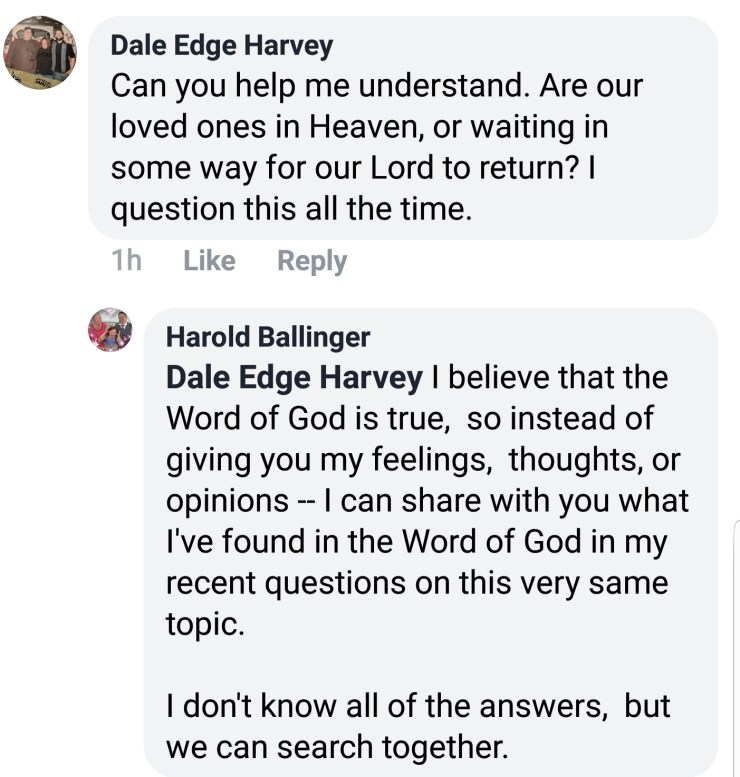
Q: Can you help me understand. Are our loved ones in Heaven, or waiting in some way for our Lord to return? I question this all the time.

A: I believe that the Word of God is true, so instead of giving you my feelings, thoughts, or opinions — I can share with you what I’ve found in the Word of God in my recent questions on this very same topic.

I don’t know all of the answers, but we can search together.

First. What is death?

Ecclesiastes 12:7 ESV
And the dust returns to the earth as it was, and the spirit returns to God who gave it.

Hebrews 9:27 ESV
And just as it is appointed for man to die once, and after that comes judgment,

Psalm 146:4 ESV
When his breath departs, he returns to the earth; on that very day his plans perish.

NOTE: I’ve found it helps to go and read the context surrounding the verses in that section of 20 or so verses in my Bible to better understand what is being said “in context” too.

Second. What does it say about those who have died?

But we do not want you to be uninformed, brothers, about those who are asleep, that you may not grieve as others do who have no hope. For since we believe that Jesus died and rose again, even so, through Jesus, God will bring with him those who have fallen asleep. For this we declare to you by a word from the Lord, that we who are alive, who are left until the coming of the Lord, will not precede those who have fallen asleep. For the Lord himself will descend from heaven with a cry of command, with the voice of an archangel, and with the sound of the trumpet of God. And the dead in Christ will rise first. Then we who are alive, who are left, will be caught up together with them in the clouds to meet the Lord in the air, and so we will always be with the Lord. Therefore encourage one another with these words.
1 Thessalonians 4:13‭-‬18 ESV

And many of those who sleep in the dust of the earth shall awake, some to everlasting life, and some to shame and everlasting contempt.
Daniel 12:2 ESV

After saying these things, he said to them, “Our friend Lazarus has fallen asleep, but I go to awaken him.” The disciples said to him, “Lord, if he has fallen asleep, he will recover.” Now Jesus had spoken of his death, but they thought that he meant taking rest in sleep. Then Jesus told them plainly, “Lazarus has died,
John 11:11‭-‬14 ESV

Third. What does it say about physical death’s purpose with regards to believers?

So is it with the resurrection of the dead. What is sown is perishable; what is raised is imperishable. It is sown in dishonor; it is raised in glory. It is sown in weakness; it is raised in power. It is sown a natural body; it is raised a spiritual body. If there is a natural body, there is also a spiritual body. Thus it is written, “The first man Adam became a living being”; the last Adam became a life-giving spirit. But it is not the spiritual that is first but the natural, and then the spiritual. The first man was from the earth, a man of dust; the second man is from heaven. As was the man of dust, so also are those who are of the dust, and as is the man of heaven, so also are those who are of heaven. Just as we have borne the image of the man of dust, we shall also bear the image of the man of heaven. I tell you this, brothers: flesh and blood cannot inherit the kingdom of God, nor does the perishable inherit the imperishable. Behold! I tell you a mystery. We shall not all sleep, but we shall all be changed, in a moment, in the twinkling of an eye, at the last trumpet. For the trumpet will sound, and the dead will be raised imperishable, and we shall be changed. For this perishable body must put on the imperishable, and this mortal body must put on immortality. When the perishable puts on the imperishable, and the mortal puts on immortality, then shall come to pass the saying that is written: “Death is swallowed up in victory.” “O death, where is your victory? O death, where is your sting?”
1 Corinthians 15:42‭-‬55 ESV

Martha said to Jesus, “Lord, if you had been here, my brother would not have died. But even now I know that whatever you ask from God, God will give you.” Jesus said to her, “Your brother will rise again.” Martha said to him, “I know that he will rise again in the resurrection on the last day.” Jesus said to her, “I am the resurrection and the life. Whoever believes in me, though he die, yet shall he live, and everyone who lives and believes in me shall never die. Do you believe this?” She said to him, “Yes, Lord; I believe that you are the Christ, the Son of God, who is coming into the world.”
John 11:21‭-‬27 ESV

“Truly, truly, I say to you, an hour is coming, and is now here, when the dead will hear the voice of the Son of God, and those who hear will live. For as the Father has life in himself, so he has granted the Son also to have life in himself. And he has given him authority to execute judgment, because he is the Son of Man. Do not marvel at this, for an hour is coming when all who are in the tombs will hear his voice and come out, those who have done good to the resurrection of life, and those who have done evil to the resurrection of judgment.
John 5:25‭-‬29 ESV

Fourth. What does it say about death with regards to those who do not have saving faith in Christ Jesus?

And do not fear those who kill the body but cannot kill the soul. Rather fear him who can destroy both soul and body in hell.
Matthew 10:28 ESV

Jesus answered him, “Truly, truly, I say to you, unless one is born again he cannot see the kingdom of God.”
John 3:3 ESV

since indeed God considers it just to repay with affliction those who afflict you, and to grant relief to you who are afflicted as well as to us, when the Lord Jesus is revealed from heaven with his mighty angels in flaming fire, inflicting vengeance on those who do not know God and on those who do not obey the gospel of our Lord Jesus. They will suffer the punishment of eternal destruction, away from the presence of the Lord and from the glory of his might,
2 Thessalonians 1:6‭-‬9 ESV

and in Hades, being in torment, he lifted up his eyes and saw Abraham far off and Lazarus at his side. And he called out, ‘Father Abraham, have mercy on me, and send Lazarus to dip the end of his finger in water and cool my tongue, for I am in anguish in this flame.’ But Abraham said, ‘Child, remember that you in your lifetime received your good things, and Lazarus in like manner bad things; but now he is comforted here, and you are in anguish. And besides all this, between us and you a great chasm has been fixed, in order that those who would pass from here to you may not be able, and none may cross from there to us.’ And he said, ‘Then I beg you, father, to send him to my father’s house— for I have five brothers—so that he may warn them, lest they also come into this place of torment.’ But Abraham said, ‘They have Moses and the Prophets; let them hear them.’ And he said, ‘No, father Abraham, but if someone goes to them from the dead, they will repent.’ He said to him, ‘If they do not hear Moses and the Prophets, neither will they be convinced if someone should rise from the dead.'”
Luke 16:23‭-‬31 ESV

For God did not send his Son into the world to condemn the world, but in order that the world might be saved through him. Whoever believes in him is not condemned, but whoever does not believe is condemned already, because he has not believed in the name of the only Son of God. And this is the judgment: the light has come into the world, and people loved the darkness rather than the light because their works were evil. For everyone who does wicked things hates the light and does not come to the light, lest his works should be exposed.
John 3:17‭-‬20 ESV

But as for the cowardly, the faithless, the detestable, as for murderers, the sexually immoral, sorcerers, idolaters, and all liars, their portion will be in the lake that burns with fire and sulfur, which is the second death.”
Revelation 21:8 ESV

Fifth. What do I do if I believe these things are true?

But God will ransom my soul from the power of Sheol, for he will receive me. Selah
Psalms 49:15 ESV

“For God so loved the world, that he gave his only Son, that whoever believes in him should not perish but have eternal life.
John 3:16 ESV

“Let not your hearts be troubled. Believe in God; believe also in me. In my Father’s house are many rooms. If it were not so, would I have told you that I go to prepare a place for you? And if I go and prepare a place for you, I will come again and will take you to myself, that where I am you may be also. And you know the way to where I am going.” Thomas said to him, “Lord, we do not know where you are going. How can we know the way?” Jesus said to him, “I am the way, and the truth, and the life. No one comes to the Father except through me.
John 14:1‭-‬6 ESV

And you were dead in the trespasses and sins in which you once walked, following the course of this world, following the prince of the power of the air, the spirit that is now at work in the sons of disobedience— among whom we all once lived in the passions of our flesh, carrying out the desires of the body and the mind, and were by nature children of wrath, like the rest of mankind. But God, being rich in mercy, because of the great love with which he loved us, even when we were dead in our trespasses, made us alive together with Christ—by grace you have been saved— and raised us up with him and seated us with him in the heavenly places in Christ Jesus, so that in the coming ages he might show the immeasurable riches of his grace in kindness toward us in Christ Jesus. For by grace you have been saved through faith. And this is not your own doing; it is the gift of God, not a result of works, so that no one may boast. For we are his workmanship, created in Christ Jesus for good works, which God prepared beforehand, that we should walk in them.
Ephesians 2:1‭-‬10 ESV

How did I get the verses?

At this Bible research site, you can type in any topic in the search bar, and it will give you verses to reference and study:

https://www.openbible.info/topics/death_and_dying

Those were some of the big questions that I had. And I had to empty my head of any preconceived notions about these things, and even put aside what “good intentioned people” might have told me — to really listen to what the Word of God has to say about such things, and be willing to not just listen to what it says, but to hear what God says through His Word.

I still have lots more questions, but I figure that’s probably more than enough for tonight.